As the United States celebrates its 250th anniversary, ReligiousLiberty.TV explores the ancient roots of religious freedom. Long before the First Amendment, figures like Tertullian argued that belief must be voluntary and not coerced. Ancient Persian rulers practiced pragmatic tolerance, and early Jewish and Christian thinkers defended the right to live by conscience. These ideas form the foundation of modern legal protections. This year, the blog will revisit the long road that led to one of the central values in American law.
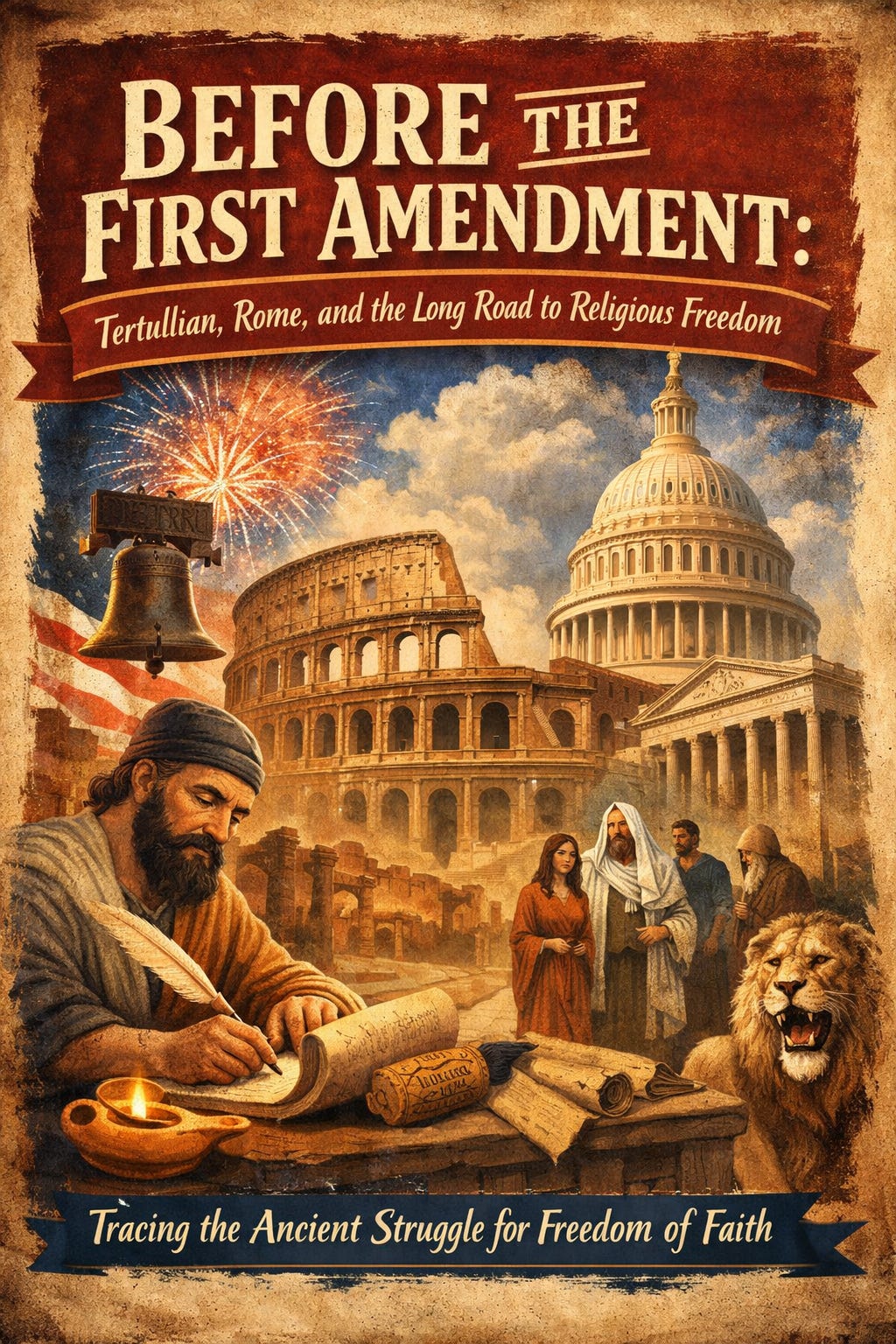
In this 250th year of the American Republic, we’re heading way, way back. Before the Founders. Before Luther. Before Constantine. Even before Christmas. To find out where this “freedom of religion” idea really started
Back before Twitter, before Jefferson, even before Jesus, people still had to figure out how not to jail or kill each other over who had the right god. It did not always go well. But sometimes, someone would pause, squint at the sky, and say, “You know what? Maybe we just let folks burn their incense or skip temple and mind our own business.”
It is America’s 250th birthday this year. A time when the flags wave a little heavier and the grill smoke smells slightly more patriotic. But if you scratch off the powdered wigs and parchment, past Jefferson’s quill and Madison’s brainwaves, you find a long and winding story. Why did we decide it was a good idea to let people believe what they believe without threatening them?
To answer that, you do not just stroll back through Williamsburg. You hop in a philosophical jalopy with a cracked windshield and drive in reverse through history at uncomfortable speeds. You cruise past the Enlightenment salons, speed through the Protestant dust-ups, slide past inquisitions, and finally skid to a stop somewhere in Roman North Africa, around the year 197. That is where a man named Tertullian put quill to parchment and wrote the ancient version of “Keep your laws off my soul.”
“It is a fundamental human right,” he wrote, “a privilege of nature, that every person should worship according to their own convictions.” That was not a polite petition for tolerance. That was a full-throated declaration that belief is personal and power has no place in it.
Tertullian was a lawyer. That usually meant defending the system. But he saw the violence and fakery that came with coerced religion. Maybe he saw fear in someone’s eyes as they mouthed prayers they did not believe. Maybe he got tired of the charade. Whatever it was, he flipped the script. He told the Empire that true belief cannot be beaten into anyone. It has to rise from within.
That idea, that conscience belongs to the individual and not the emperor, was not invented in Philadelphia. It was hammered out in Roman prisons and dusty desert provinces by people who had more to lose than to gain by saying it out loud.
Before Tertullian, tolerance was mostly a matter of policy, not principle. Back in 539 before the common era, Cyrus the Great of Persia let displaced communities return home and worship how they pleased. He was not being philosophical. He figured things ran smoother when you were not burning down someone else’s altar. Rome picked up on that idea. For a while, they let most cults operate freely, as long as people paid taxes and kept quiet.
If you refused to sacrifice to the emperor, or if you claimed a higher loyalty, then Rome had a problem. That is where Christians, and before them many Jews, ran into trouble. They were not trying to be rebels, but their beliefs clashed with the expectations of the state.
Even before Christianity gained momentum, Jewish communities had to navigate a world where imperial peace required religious participation. Think of Philo of Alexandria. He tried to explain Jewish customs to Greek readers as ancient, honorable, and not a threat to Roman authority. He was not asking for special treatment. He was arguing that living according to one’s beliefs should not be treated as a crime.
By the time Christianity arrived, that balance collapsed. Early followers of Jesus were not just nonconformists. They were actively refusing to perform public rituals that Rome considered civic duty. It was not the theology that bothered the Empire. It was the refusal to play along.
Tertullian knew this pressure. He pushed back. His writings did not just defend Christians. He argued for religious freedom for everyone. For pagans. For people with unusual beliefs. Because, he said, “It is assuredly no part of religion to compel religion.” Real conviction had to come freely, or it was not real at all.
That principle, that sincere belief cannot be forced, echoed through the centuries. Lactantius, another early Christian thinker, said something similar in the early fourth century. “Religion cannot be imposed by force. The matter must be carried on by words rather than by blows.” That line would not look out of place in a modern court ruling.
This was not only a Christian idea. Roman poets like Lucretius warned that religion used for control could lead to cruelty. Plutarch noted that different peoples honored the divine in different ways and seemed fine with it. The philosophical soil was there. But it took persecution to make the idea grow.
When the American founders wrote the First Amendment, they were not starting from scratch. They were writing down the lessons of centuries of resistance. They had read Locke and Montesquieu. But they also inherited a longer story. A story in which people argued for liberty of conscience with no armies behind them. Just words. And courage.
The belief that faith must be free did not arrive with muskets and powdered wigs. It walked through history, slowly. Sometimes barefoot. Often bleeding.
So this year, while the fireworks pop and the flags wave, we will be looking back. Not just to 1776. To 197. To 539. To the centuries when people stood up, quietly or loudly, and said: “What I believe is not yours to control.” Not because it was safe. But because it was right.
All year long, ReligiousLiberty.TV will be tracing these voices. Voices from Carthage. From Persia. From Alexandria. From the margins. Voices that helped define what we now call the first freedom.
Enjoyed this article? Like, share, and subscribe to the ReligiousLiberty.TV blog at religiouslibertytv.substack.com for breaking news, case updates, and in-depth features on conscience rights and law.
Disclaimer:
This article does not constitute legal advice. Readers should consult a licensed attorney for legal guidance about specific cases.
This article is informational and not legal advice. For personal legal questions, contact a licensEd attorney.
