Long before sleigh bells and North Pole legends, Nicholas of Myra stood in chains for his faith and walked into a council that would shape Christian belief for millennia.
He never meant to become Santa Claus.
The man we now wrap in red velvet and sleigh bells once sat in a Roman prison cell, bruised and likely malnourished, for refusing to call Caesar “lord.” Long before he was the patron saint of children and sailors, Nicholas of Myra was a bishop who risked everything—freedom, reputation, even life itself—to stand by a truth he would not betray.
What followed wasn’t myth. It was blood, doctrine, exile, and the birth of the fundamental Christian creed that forms the foundation of most branches of Christianity to this day.
Before the legend, there was a man in chains.
Nicholas was born sometime around 270 AD in Patara, a city in the Roman province of Lycia, in what is now southern Turkey. He came of age at the height of the Roman Empire. His parents died young, leaving him a substantial inheritance, which he reportedly gave away in secret to help the poor. But it wasn’t his wealth that drew attention. It was his loyalty to Christ, not Caesar.
In 303 AD, Emperor Diocletian launched the last and most violent of the imperial persecutions. Churches were to be destroyed. Scriptures burned. Bishops arrested. Christianity, in the eyes of the state, was not a religion. It was rebellion.
Nicholas, by then Bishop of Myra, refused to compromise. He was arrested and jailed. Early Church sources record his imprisonment, likely in filthy, overcrowded Roman cells. Torture was common. Death, expected.
But Nicholas survived.
In 313 AD, Emperor Constantine issued the Edict of Milan, legalizing Christianity. Nicholas was released and returned to his post. But the empire he re-entered was no longer merely hostile to Christians. It was now Christian in name, but bitterly divided on doctrine.
The Council of Nicaea: When the Church split over Christ
By 325 AD, Constantine faced a new problem. The empire, newly unified under his rule, was now fractured by a theological war that threatened to become political. At the center of it was a question most emperors wouldn’t have cared about: Was Jesus Christ fully divine?
A priest named Arius from Alexandria said no. Arius taught that Jesus had been created by God the Father and was not co-eternal with Him. According to Arius, there was a time when the Son did not exist. Christ, he believed, was exalted above all creation, but not equal to God Himself.
The implications were massive. If Arius was right, Christ was not truly divine, and Christian worship of Jesus could be idolatry. If Arius was wrong, he was undermining the heart of Christian belief.
Constantine, eager to end the division, convened the First Council of Nicaea. It was the first ecumenical council in Christian history, and it drew more than 300 bishops from across the Roman world. Nicholas of Myra was among them.
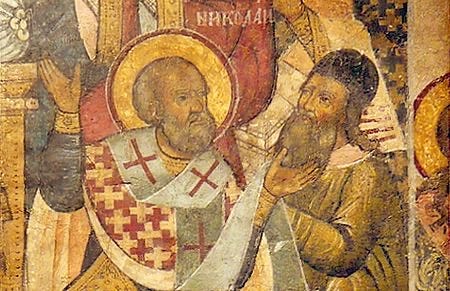
There are no surviving minutes that mention Nicholas by name. But later sources, including accounts from the Eastern Orthodox Church, record a dramatic confrontation. According to these traditions, when Arius stood to defend his views, Nicholas listened silently and then walked across the chamber and slapped him across the face.
The room fell silent.
Nicholas was reportedly rebuked by his fellow bishops and briefly stripped of his office. But the legend doesn’t end there. That night, the story goes, Christ and the Virgin Mary appeared to several bishops in a dream, restoring Nicholas’s authority.
Whether the story is literal or symbolic, it captures something true about Nicholas: he would not remain silent when truth was at stake.
The Outcome: The Nicene Creed and a Church divided
The Council of Nicaea ultimately rejected Arius’s view. The bishops crafted what is now known as the Nicene Creed, a declaration that affirmed the full divinity of Christ:
“We believe in one Lord Jesus Christ,
the only-begotten Son of God,
begotten of the Father before all worlds,
Light of Light, very God of very God,
begotten, not made, being of one substance
with the Father…”
The phrase “of one substance with the Father” (homoousios in Greek) directly contradicted Arius’s teaching. The council voted overwhelmingly against Arius. Out of the 318 bishops present, only two refused to sign the creed. Arius was declared a heretic. His writings were ordered to be burned. He was exiled.
But the decision didn’t end the conflict. Arius would later return from exile with the help of sympathetic emperors. Debates over the nature of Christ would last for generations and erupt again at future councils. But Nicaea laid the foundation for Christian orthodoxy.
And Nicholas? He returned to Myra, again quietly, again faithfully. He resumed his work among the poor. He gave in secret. He prayed for those who hated him. He stood where others stumbled.
From the Council to the Chimney: How Nicholas Became Santa Claus
Nicholas died around 343 AD. His reputation for generosity and protection of the innocent spread across Europe. In the centuries that followed, his feast day, December 6, became a day of gift-giving in many cultures.
In the Netherlands, he was called Sinterklaas. Dutch immigrants brought that tradition to America, where “Sinterklaas” became “Santa Claus.” Over time, his bishop’s robes were replaced with fur trim and red velvet. His face grew rounder. His mission, simpler.
But something real got buried in that transformation.
Beneath the sleigh and the sack of toys is a man who stood at a turning point in history, when the church was being torn apart from the inside and hunted from the outside. A man who went to prison rather than lie. Who risked his life for doctrine.
We remember the gifts. But we should not forget the chains.
The Nicene Creed
I believe in one God, the Father almighty, maker of heaven and earth, of all things visible and invisible.
I believe in one Lord Jesus Christ, the Only Begotten Son of God, born of the Father before all ages. God from God, Light from Light, true God from true God, begotten, not made, consubstantial with the Father; through him all things were made. For us men and for our salvation he came down from heaven, and by the Holy Spirit was incarnate of the Virgin Mary, and became man. For our sake he was crucified under Pontius Pilate, he suffered death and was buried, and rose again on the third day in accordance with the Scriptures. He ascended into heaven and is seated at the right hand of the Father. He will come again in glory to judge the living and the dead and his kingdom will have no end.
I believe in the Holy Spirit, the Lord, the giver of life, who proceeds from the Father and the Son, who with the Father and the Son is adored and glorified, who has spoken through the prophets.
I believe in one, holy, catholic and apostolic Church. I confess one Baptism for the forgiveness of sins and I look forward to the resurrection of the dead and the life of the world to come. Amen.