
Hollywood is broken, the media’s fragmented, and pop culture no longer speaks to a country that no longer speaks to itself.
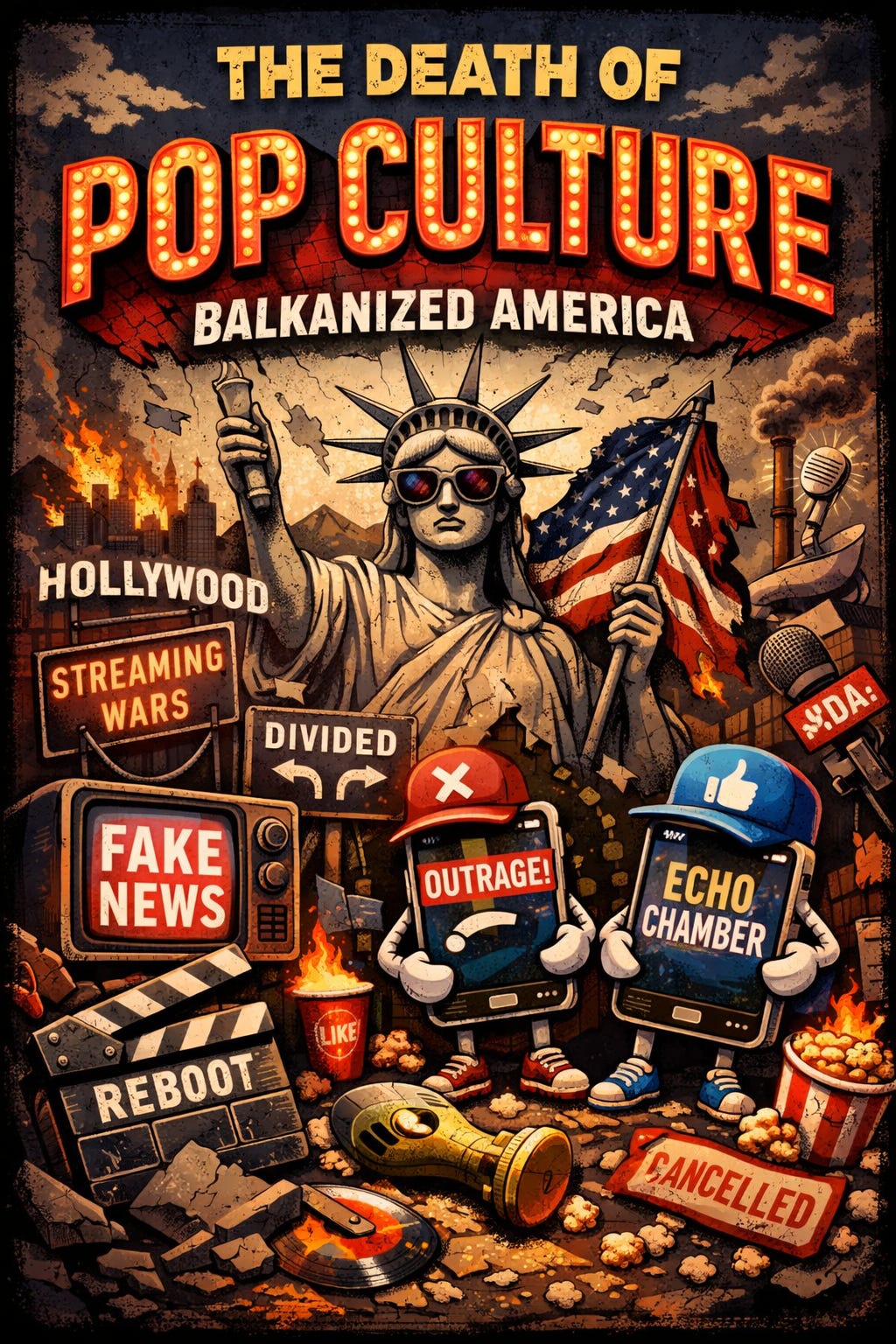
There was a time when pop culture gave America a shared story. A single TV show could spark national debate. A film premiere was a civic event. Radio hits became cultural markers. Whether you loved it or hated it, you knew what was happening. Everyone did. Today, those moments are gone. What we’re left with is content, splintered across a thousand platforms, designed not to provoke or inspire, but to pacify and segment.
The center of American culture has collapsed. Pop culture is dead—not because it failed, but because it succeeded too well and then spread too thin. The machinery of entertainment, once aimed at the nation as a whole, now targets fractured slices of a population that no longer shares much in common. What used to unite us now reflects how far apart we’ve drifted.
This isn’t just about Hollywood running out of ideas, though it has. It’s about the fragmentation of society itself. American culture has been balkanized. Political identities are now cultural ecosystems. One group follows The Daily Show, another listens to The Joe Rogan Experience. One watches The Crown, the other won’t watch anything unless it stars Tim Allen. These aren’t just preferences. They are signals of tribal allegiance. If someone mentions Taylor Swift, you already know how they vote.
The award shows now look like museums curating artifacts from a culture that barely exists. The Oscars announce Best Picture winners that few people have seen. The Emmys celebrate shows most Americans haven’t heard of. The ratings continue to fall, not because the audiences have no taste, but because the events are no longer cultural touchstones. They’re industry rituals, watched mostly by the people who work in the business. A statue handed out on stage means little if the public doesn’t know or care who received it. The disconnect between prestige and participation is the clearest signal that pop culture no longer belongs to everyone. It belongs to no one.
Studios and networks, once the architects of cultural cohesion, now act more like surveyors of niche markets. Focus groups have replaced vision. Risk is managed, not taken. The result is a cultural landscape in which nothing resonates beyond the confines of its intended audience. Films break box office records and vanish from memory. TV shows trend for 48 hours and are never mentioned again. Even the controversies are prepackaged and forgotten before they finish trending.
And the media, once tasked with holding the conversation together, now fuels the fracture. Cable news doesn’t inform a nation—it sustains separate realities. The New York Times tells its readers what they already believe, while Fox News does the same for theirs. Journalism used to be an uncomfortable but necessary mirror. Now it’s an affirmation generator.
But the deeper problem isn’t what these institutions are doing; it’s what the audience now expects. Pop culture has become a service, not a signal. Consumers are trained to expect personalization. You don’t want the show of the year. You want your show, curated to your taste, worldview, and attention span. The algorithm serves it up. You click. And you stay inside your lane, far from anyone watching something else.
This self-sorting has turned the culture from a conversation into parallel monologues. There’s no common ground because no one’s looking for it. Balkanization isn’t coming. It’s here. And it hasn’t just torn politics apart; it’s shredded the culture that once made those politics legible.
In the past, a great film, a viral moment, or a shared tragedy could realign public attention. Now, even the biggest events fracture along pre-existing lines. A police shooting, a protest, a court ruling—each one splinters into competing narratives before facts can take shape. Every reaction is processed through a tribal lens, every story weaponized.
The irony is that the more content we consume, the less we share. Culture has become a buffet without a table. Everyone is eating, but no one is dining together. And the institutions that once hosted those meals—Hollywood, the press, even the music industry—now operate like ghost kitchens. You place your order, it arrives. You never see who else is eating.
The death of pop culture didn’t come from lack of creativity alone. It came from a society that no longer agrees on what stories matter, or even what counts as real. There’s no longer a “mainstream,” just overlapping currents that never touch.
That doesn’t mean culture is over. But it does mean the era of shared symbols is gone. What takes its place might still be meaningful—but it will be tribal, isolated, and shaped less by what we love than by what we refuse to hear.
TLDR (Too Long / Didn’t Read Summary)
American pop culture has splintered because society itself has fractured. Hollywood produces for narrow segments, not a shared public. Award shows now celebrate content that large swaths of the country never see. Media reinforces political tribes. Algorithms push us deeper into isolated preferences. The result is a fragmented cultural landscape with no common stories or reference points—only parallel content streams shaped by identity and ideology.
Like this article? Share it, forward it to friends, and subscribe to the ReligiousLiberty.TV blog at https://religiouslibertytv.substack.com for early access to cultural and legal analysis, breaking developments, and independent reporting that cuts through the noise.
SEO Tags:
pop culture balkanization, award show ratings decline, hollywood fragmentation, tribal media habits, cultural collapse 2026
