
Judges rule that religious freedom does not grant protestors the right to block private property or bypass criminal prosecution.
TLDR
The Arizona Court of Appeals ruled that the state did not violate the Free Exercise of Religion Act (FERA) by arresting and prosecuting protestors at a Raytheon facility. While the court acknowledged the protestors acted on sincerely held religious beliefs, it held that the state has a compelling interest in protecting private property and public peace. The court determined that arrest and prosecution were the least restrictive means to achieve these goals. The decision clarifies that law enforcement is not required to wait indefinitely for protestors to leave. It also affirms that courts will not interfere with a prosecutor’s decision to bring charges. This case establishes clear boundaries between religious exercise and private property rights in Arizona.
Case Information
• Caption: Hubersberger v. State
• Court: Arizona Court of Appeals, Division Two
• Date: February 9, 2026
• No.: 2 CA-CV 2025-0188
Arizona law allows the state to prosecute individuals for trespassing on private property even when the conduct is religiously motivated. The government’s interest in maintaining peace and property rights outweighs religious protections when no effective alternatives to arrest exist. This ruling confirms that a religious belief does not provide immunity from neutral criminal laws.
This decision interprets the Arizona Free Exercise of Religion Act (FERA) in the context of civil disobedience. It addresses whether law enforcement must use “less restrictive” measures, such as waiting for protestors to leave, before making arrests. The ruling provides a roadmap for how courts balance fundamental religious rights against the rights of property owners and the discretion of the executive branch.
What are the facts of the Hubersberger v. State case?
• In November 2023, four individuals protested outside a Raytheon facility in Pima County.
• The group acted on religious beliefs regarding the conflict in Gaza and Raytheon’s role as a weapons supplier.
• Protestors blocked workers from entering the facility by standing on private property.
• Sheriff’s deputies told the group they were trespassing.
• Officers told the group to protest on public land “mere steps away”.
• The individuals refused to move.
• Deputies arrested them and cited them for misdemeanor criminal trespass.
How does the Arizona Free Exercise of Religion Act apply here?
FERA protects the fundamental right to exercise religion without undue government interference. The government cannot burden a person’s religious exercise without a compelling reason. The superior court agreed that the arrests burdened the protestors’ religious beliefs. However, the state has a compelling interest in protecting the peace and private property. This statute mirrors the federal Religious Freedom Restoration Act (RFRA). It allows religion to be used as a claim or a defense in court.
Why was the arrest considered the least restrictive means?
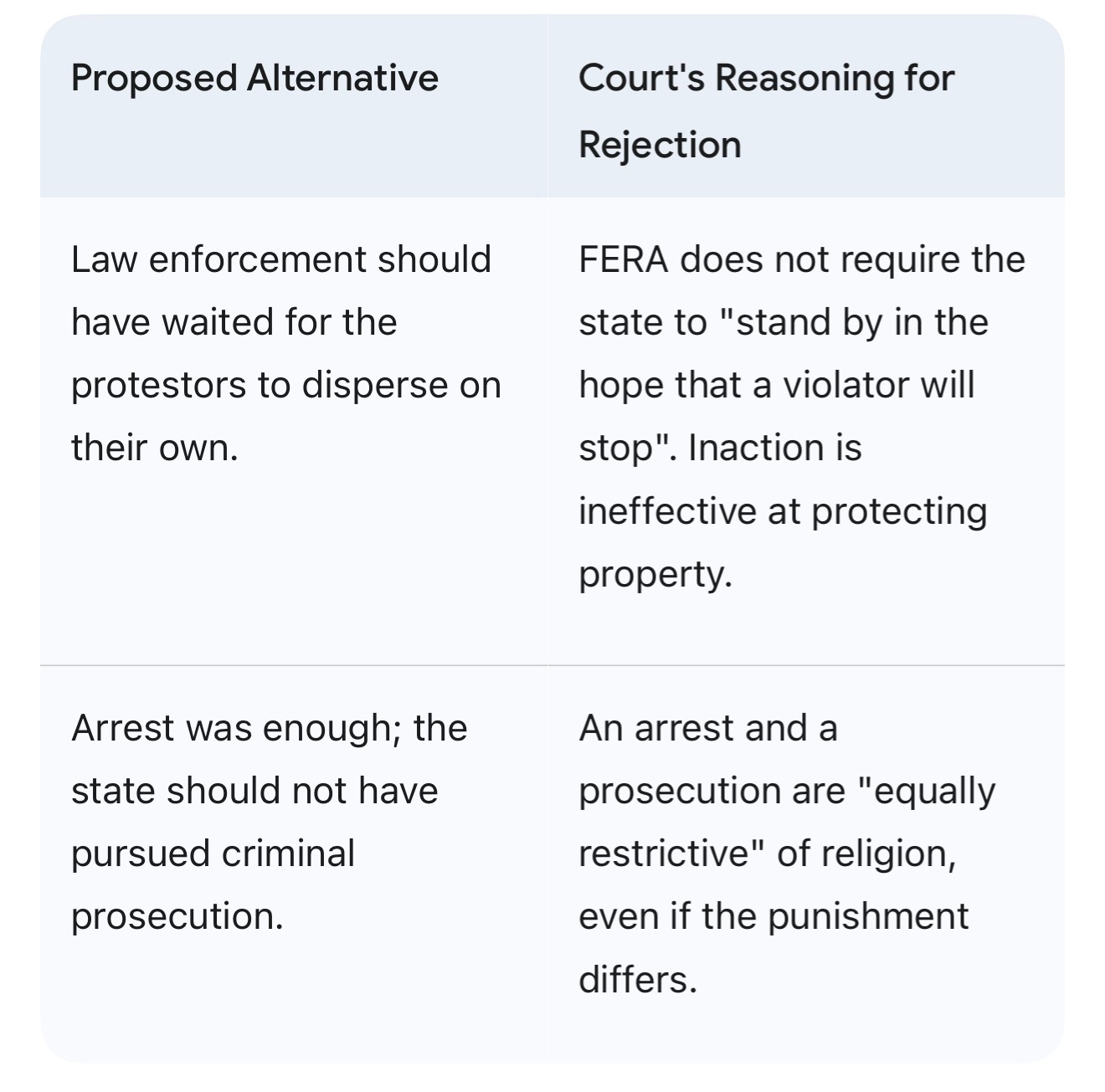
The appellants argued that deputies should have waited for them to leave on their own. The court rejected this idea. The law does not require the state to stand by and hope a violator stops offending. Taking no action is ineffective for protecting property rights. The protestors refused to move to nearby public property. Therefore, waiting was an impractical alternative. The state met its burden by showing other options were ineffective.
Can the court stop the prosecution of religious protestors?
The protestors argued that the arrest was enough to clear the property. They claimed further prosecution was unnecessary. The court disagreed. An arrest and a prosecution are equally restrictive of religion. Stopping a prosecution would interfere with executive power. Judges generally avoid reviewing basic exercises of prosecutorial discretion. The state’s power to prosecute remains a necessary tool for furthering its interests.
Legal Commentary
The law is clear on property rights. You have a right to believe what you want. You do not have a right to use your neighbor’s driveway as a pulpit. These protestors claimed their faith gave them a pass to block a private business. The court correctly saw through this. Religious freedom is a shield against government overreach. It is not a sword to be used against the rights of others.
The “least restrictive means” test is a high bar for the state. It is not an impossible bar. The protestors suggested the police should have waited. That is a fantasy. Law enforcement has a job to do. If someone refuses to move after a warning, an arrest is the logical next step. Waiting for a lawbreaker to get tired of breaking the law is not a policy. It is a surrender of public order.
There is a separate issue of prosecutorial discretion. The protestors wanted the court to tell the prosecutor to drop the charges. That is a dangerous request. We have a separation of powers for a reason. The executive branch decides who to charge. The judicial branch decides if the law was followed. If judges start picking and choosing which valid charges to allow based on the defendant’s motive, the system collapses.
This ruling protects the rule of law. It tells every citizen that their beliefs are respected but their actions have consequences. You can protest. You can pray. You can even get arrested for what you believe is right. You just cannot expect the court to rewrite the trespass laws for you. This decision keeps the focus on the act of trespassing, where it belongs.
Citations
• Hubersberger v. State, No. 2 CA-CV 2025-0188 (Ariz. App. Feb. 9, 2026).
• Arizona Revised Statutes §§ 41-1493 to 41-1493.04.
• State v. Hardesty, 222 Ariz. 363 (2009).
• United States v. Christie, 825 F.3d 1048 (9th Cir. 2016).
Subscription Call
Like, share, and subscribe to ReligiousLiberty.TV for breaking news and case info. Subscribers get access to breaking news and case information.
Disclaimers
AI Disclaimer: This article was assisted by AI.
Legal Disclaimer: This does not constitute legal advice. Readers are encouraged to talk to licensed attorneys about their particular situations.
Tags
Arizona Law, Religious Freedom, FERA, Private Property Rights, Raytheon Protest
Holding: Religious motivation does not provide immunity from neutral criminal laws protecting private property; the state may prosecute trespassers even when conduct is religiously motivated when it serves compelling governmental interests.