
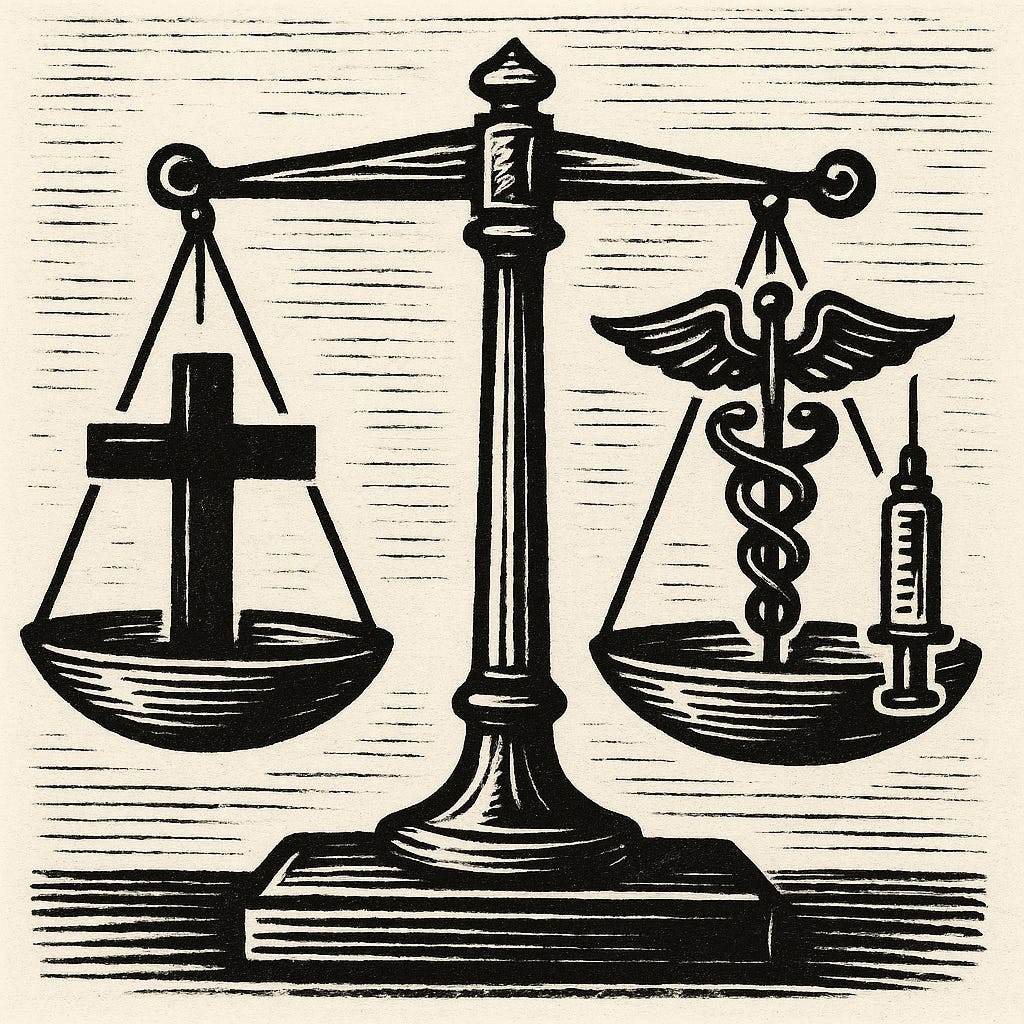
In the United States, disputes over religious exemptions to vaccines often surface when outbreaks of preventable diseases coincide with falling vaccination rates. Parents seeking to avoid immunization mandates frequently invoke the First Amendment, citing sincerely held religious beliefs.
Religious exemptions raise a core tension: the government’s obligation to protect public health versus individuals’ rights to exercise religious freedom. While nearly every state requires childhood vaccinations for school entry, laws vary widely on whether exemptions are allowed, and if so, under what conditions.
Since the early 20th century, courts have upheld the authority of states to mandate vaccinations. In Jacobson v. Massachusetts (1905), the U.S. Supreme Court ruled that individual liberty does not override the state’s power to enact reasonable public health laws. In Prince v. Massachusetts (1944), the Court affirmed that parental authority and religious freedom cannot be used to endanger a child’s welfare. Neither case explicitly recognized a constitutional right to religious exemptions.
Today, 44 states permit religious exemptions, but six—California, Connecticut, Maine, Mississippi, New York, and West Virginia—have eliminated them following disease outbreaks. Courts reviewing challenges to those repeals have generally upheld the states’ decisions, concluding that legislatures are not required to offer religious accommodations in vaccine laws.
The Religious Objections in Detail
Religious objections to vaccines are diverse, though few major religious institutions officially prohibit vaccination. Instead, most objections arise from individual interpretations of doctrine:
-
Christian denominations: Some Christians object to vaccines developed with cell lines derived from elective abortions in the 1960s. While the Vatican and many Protestant leaders permit vaccination under moral necessity, individual believers continue to refuse on ethical grounds.
-
Jehovah’s Witnesses: While the denomination no longer bans vaccines, some adherents object based on principles of bodily purity.
-
Christian Science: Followers emphasize prayer over medical treatment. The Church of Christ, Scientist does not forbid vaccination but leaves it to personal conscience.
-
Amish communities: Resistance often arises from cultural traditions of self-reliance and natural living rather than theology, though it is sometimes framed as religious.
-
Islam: Some object to vaccines with pork-derived gelatin. However, many Islamic authorities permit them when necessary to preserve health.
-
Judaism: Most rabbinical authorities encourage vaccination, but individual objections based on kosher law or bodily sanctity sometimes arise.
Courts generally defer to the sincerity of religious beliefs rather than evaluating theological validity. A belief does not need to be consistent with official doctrine to qualify as “religious” under the law.
Pretextual “Religious” Concerns
Public health officials and courts have noted that some individuals use “religious” exemptions as a cover for non-religious objections. These pretextual claims often mask concerns about vaccine safety, distrust of pharmaceutical companies, or general opposition to government mandates.
Studies support this. In 2019, New York’s Department of Health reported that nearly 96 percent of religious exemption requests for schoolchildren included boilerplate language about “toxins” and “natural immunity,” with little reference to faith. Connecticut, which repealed its exemption in 2021, found a similar pattern: exemption requests spiked in areas with active anti-vaccine organizing, suggesting non-religious motivations.
How Common Are Religious Exemptions?
The Centers for Disease Control and Prevention (CDC) tracks exemption rates in kindergarteners. For the 2021–22 school year, 2.6 percent of kindergarteners nationally had exemptions. Of those:
-
0.2 percent were medical exemptions.
-
2.4 percent were non-medical exemptions, almost entirely religious.
In states that allow only medical exemptions, exemption rates remain below 1 percent. By contrast, in states with broad religious carve-outs, exemption rates can exceed 5 percent in some districts, creating conditions for outbreaks.
The Stem Cell Debate
One of the most persistent religious objections involves vaccines developed using human fetal cell lines. The most cited are WI-38 (developed in Sweden in 1962 from lung tissue of an aborted fetus) and HEK-293 (derived in 1973 in the Netherlands). These immortalized cell lines have been used to grow viruses needed for vaccine development, including rubella, varicella, hepatitis A, and some COVID-19 vaccines.
It is important to note: the original fetal cells were used to establish the line, but the cells used in laboratories today are thousands of generations removed. No actual fetal tissue is present in the final vaccine. In most cases, the cells serve as “factories” to grow weakened or inactivated viruses, which are then purified before formulation.
The same cell lines have also been used in the development or testing of common medications, including Tylenol, Advil, aspirin, Pepto-Bismol, Benadryl, Sudafed, Lipitor, and many chemotherapy drugs. This creates a common inconsistency: some individuals who reject vaccines on fetal cell line grounds nevertheless use over-the-counter or prescription drugs developed or tested in the same way.
The “Most-Favored-Nation” Theory and Free Exercise
Recent Supreme Court decisions on religious liberty have invoked a “most-favored-nation” theory of the Free Exercise Clause. This doctrine, articulated in Fulton v. City of Philadelphia (2021) and other cases, holds that if a government provides exemptions for secular reasons, it must also extend exemptions for religious reasons on equal terms.
Applied to vaccines, the theory raises a question: if states allow medical exemptions, must they also allow religious exemptions? Courts have largely answered no. They distinguish medical exemptions, which are rooted in health necessity, from religious exemptions, which are matters of conscience. Because medical exemptions are considered essential to protect those who cannot safely be vaccinated, courts have not required legislatures to create religious exemptions in parallel.
For secular individuals, the question is sharper. If a person objects to vaccination for deeply held moral or philosophical reasons but is not religious, they generally receive no protection under the Free Exercise Clause. Courts have consistently held that secular conscience does not carry the same constitutional protection as religious belief in this context. Some states once recognized “philosophical” exemptions, but legislatures may repeal them without violating constitutional rights, just as they may repeal religious exemptions.
The Legal Landscape
Supporters of exemptions argue that the First Amendment’s Free Exercise Clause should protect individuals who object on faith grounds. Opponents counter that exemptions undermine herd immunity, especially for vulnerable populations who cannot be vaccinated for medical reasons.
Recent challenges have confirmed legislatures’ broad authority. In 2019, when New York repealed its religious exemption following a measles outbreak, parents sued, claiming the law violated their religious liberty. Courts dismissed the challenges, holding that the state was within its rights to eliminate exemptions in order to safeguard public health. Similar rulings have been issued in Connecticut and California.
The Broader Conflict
While major faith traditions rarely mandate rejection of vaccines, U.S. law places weight on individual religious conscience. This has created a landscape where religious exemptions exist not because religious institutions broadly forbid vaccines, but because the First Amendment protects personal interpretations of faith—even when those claims sometimes overlap with secular or pretextual objections.
Future developments are likely to focus on how states distinguish between sincere religious objections and philosophical opposition, and whether the “most-favored-nation” approach gains traction in lower courts. With ongoing litigation in states that recently repealed exemptions, the courts will continue to clarify how far protections for religious liberty extend in the vaccination context.
Commentary
The legal battle over religious exemptions to vaccines is part of a larger debate about how far constitutional protections extend into public health. On one side, the government has a compelling interest in preventing outbreaks and protecting vulnerable populations. On the other, the Free Exercise Clause guarantees individuals the right to live according to their faith, even when that conflicts with public policy.
The “most-favored-nation” theory complicates the issue. If governments allow medical exemptions, some argue, then religious exemptions must be equally available. But courts have not embraced that extension, reasoning that medical exemptions are fundamentally different. They address safety and necessity, not conscience. This distinction has so far prevented the doctrine from reshaping vaccine law.
Secular objectors remain in a weaker position. While they may hold deeply personal moral convictions against vaccination, the courts have consistently refused to equate secular conscience with religious belief under the Free Exercise Clause. Unless legislatures create philosophical exemptions by statute, secular opponents cannot claim the same protections as religious adherents.
Ultimately, the debate highlights a paradox: exemptions are often justified on grounds of liberty, but they risk undermining the collective safety that makes liberty possible. As courts continue to navigate this tension, the question remains whether religious exemptions can be preserved without opening the door to widespread avoidance of public health requirements.
Tags: vaccine mandates, religious exemptions, most-favored-nation theory, fetal cell lines, First Amendment
TL:DR
Religious exemptions to vaccines remain one of the most contested areas of U.S. law and public health. While 44 states still allow them, six have repealed exemptions after outbreaks of measles and other preventable diseases. Objections vary: some Christians reject vaccines tied to fetal cell lines, certain Muslims question pork-derived ingredients, and Christian Scientists emphasize prayer over medicine. Yet studies show many “religious” exemptions cite safety concerns rather than faith, raising questions of pretext. Courts have also addressed the “most-favored-nation” theory of religious liberty, which requires governments to extend religious accommodations if similar secular ones exist. While medical exemptions are permitted everywhere, courts have declined to treat them as equivalent to religious claims, limiting the doctrine’s reach. Secular objectors, meanwhile, receive no constitutional protection. Future cases may refine these boundaries further.
Holding: Parental authority and religious freedom cannot be used to endanger a child's welfare.
Holding: Individual liberty does not override the state's power to enact reasonable public health laws requiring vaccinations.