
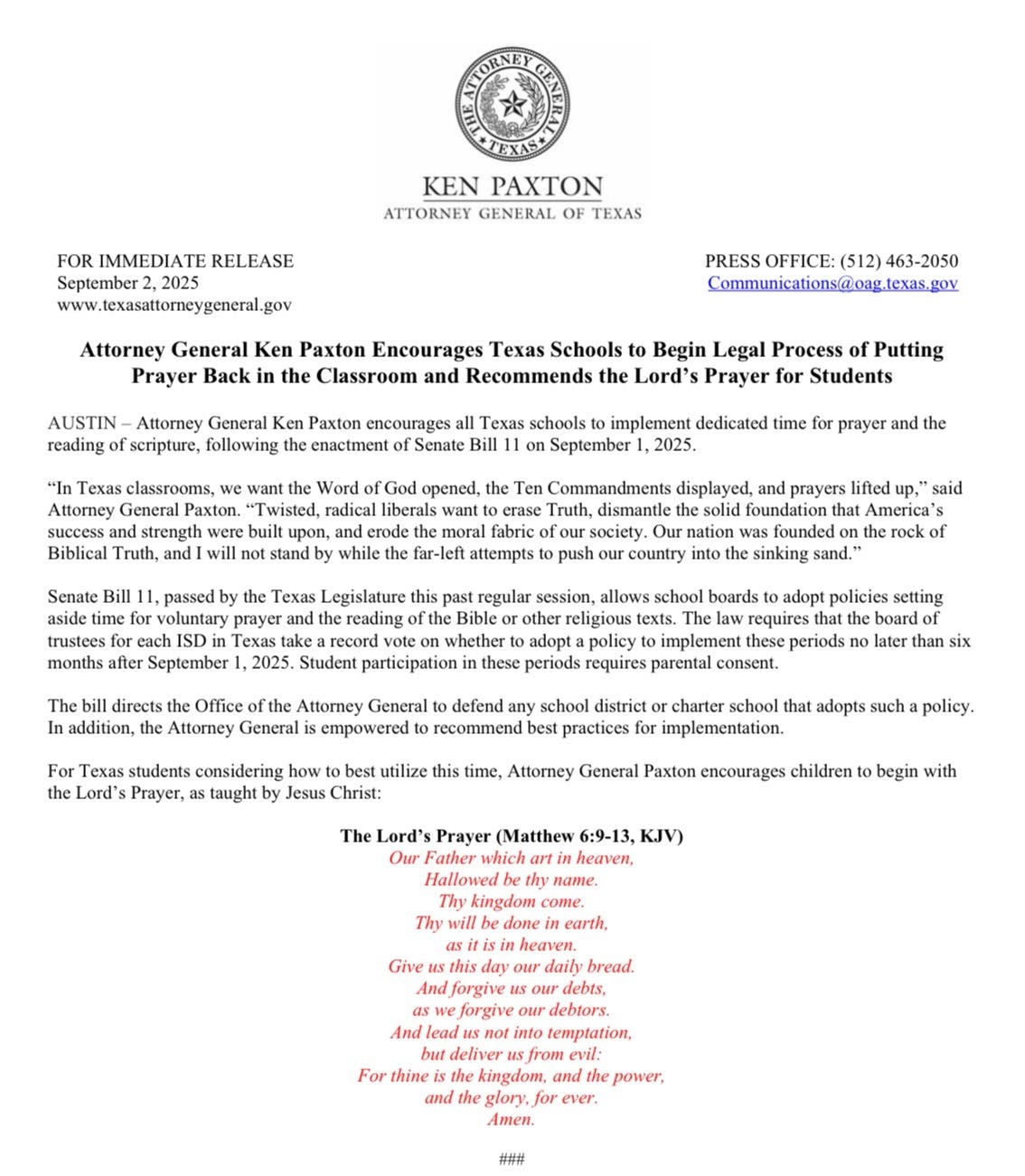
AUSTIN — On September 2, Texas Attorney General Ken Paxton told every school district in the state to clear their throats and prepare for prayer. Backed by Senate Bill 11, which became law September 1, Paxton urged schools to begin with the Lord’s Prayer from the King James Bible.
The law forces every Texas school board to take a recorded vote within six months. By March 2026, no district can dodge the issue. Parents must sign off for student participation, but once a board votes yes, prayer will become an official part of the school day. Paxton promised to defend any district that adopts the policy from the lawsuits already circling like buzzards.
“Twisted, radical liberals want to erase Truth, dismantle the solid foundation that America’s success and strength were built upon, and erode the moral fabric of our society,” Paxton said. “Our nation was founded on the rock of Biblical Truth, and I will not stand by while the far-left attempts to push our country into the sinking sand.”
On paper the law looks straightforward. In reality it is a carnival of absurdities. Picture the scenes:
-
In Houston, a teacher who has never believed in God stands still at the blackboard while her students recite the Lord’s Prayer. She does not fold her hands. She does not bow her head. The children glance up mid-prayer to see if she will break. The ritual becomes less about faith and more about watching her silence.
-
In Amarillo, a Muslim seventh grader bows politely but says nothing. Her classmate leans over and hisses “Say it.” The teacher does not notice. The girl goes home that evening and asks her father why the state has forced her to stand in front of thirty kids as the outsider.
-
In Dallas, a Catholic boy raises his hand and objects to the Protestant version of the Lord’s Prayer written on the board. His teacher shrugs, citing the Attorney General’s guidance. The boy goes home and tells his priest that Texas schools have now managed to restart the Reformation in middle school homeroom.
This is what “voluntary” looks like once it hits the classroom. Every child is cast in a role. The believer, the dissenter, the outsider, the snitch. Every teacher is forced into performance. Participation or defiance, either choice is political theater.
And hanging above it all will be the Ten Commandments posters. Another law passed by Texas lawmakers requires classrooms to display them. Together the prayer law and the commandments mandate transform classrooms into a hybrid space. Part civics lesson, part Sunday service, part courtroom exhibit.
The Supreme Court has warned against this before. In Engel v. Vitale (1962), the Court ruled that “it is no part of the business of government to compose official prayers for any group of the American people” (370 U.S. 421). In Lee v. Weisman (1992), it struck down clergy-led prayers at graduation, pointing to the coercive pressure students feel when authority directs faith (505 U.S. 577). Texas now walks straight into that same fire.
The irony is sharp. Prayer has never needed government help. Families and churches have kept it alive in kitchens, living rooms, pews, and bedrooms for centuries. When the state takes it over, it loses authenticity. A grandmother kneeling with her grandchild at bedtime is prayer. A teenager muttering words while staring at a teacher who refuses to join is not prayer. It is compliance.
Yet the machine is moving. Between now and March 2026, school board meetings will look like tent revivals welded onto town hall brawls. Parents will wave Bibles. Lawyers will recite First Amendment cases like scripture. Pastors will thunder from microphones. Students will sit in folding chairs texting about how their school board just turned into a circus.
Once the votes are cast the lawsuits will come. Judges will dig up Engel, Weisman, and every other precedent they can find. Texas will argue religious liberty. Plaintiffs will argue coercion. And somewhere in the middle, children will sit in classrooms under the hum of fluorescent lights, staring at Ten Commandments posters, wondering if they should bow their heads or just keep their eyes open and wait for the bell.
By March 2026, the votes will be in. By summer the court fights will begin. And the same question asked in 1962 will echo again. Is prayer in school a matter of freedom, or a matter of the state telling children when and how to talk to God.
Sources:
-
Engel v. Vitale, 370 U.S. 421. Supreme Court of the United States. 1962. Justia, https://supreme.justia.com/cases/federal/us/370/421/
-
Lee v. Weisman, 505 U.S. 577. Supreme Court of the United States. 1992. Justia, https://supreme.justia.com/cases/federal/us/505/577/
-
Walters, Edgar. “Texas Senate Approves Bill Requiring Ten Commandments in Classrooms.” Texas Tribune, 20 Apr. 2023, https://www.texastribune.org/2023/04/20/texas-ten-commandments-school-bill/.
Tags: Texas schools prayer, Ken Paxton Senate Bill 11, Texas Ten Commandments classrooms, voluntary prayer law Texas, school prayer lawsuits