
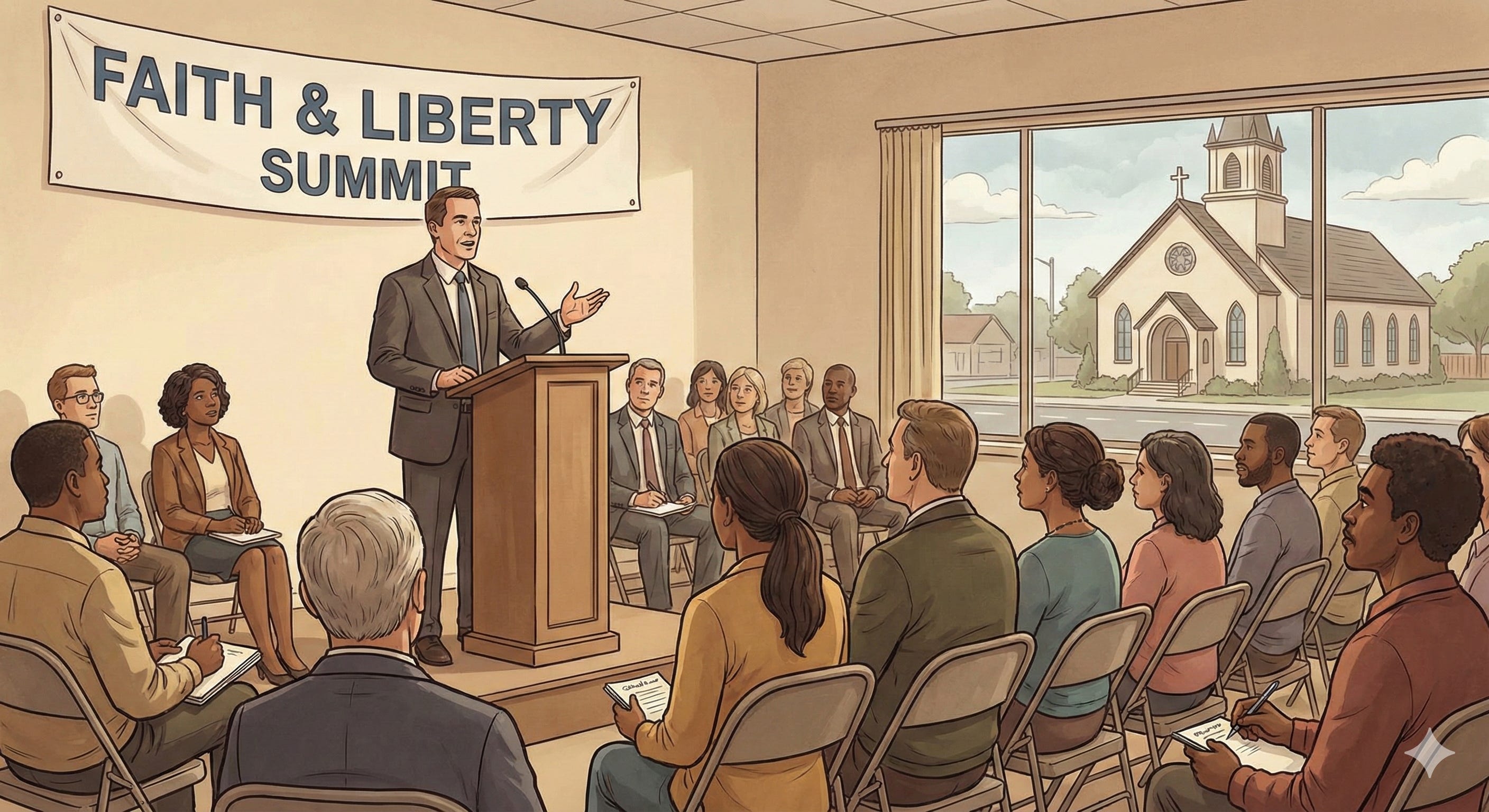
On the morning of January 17, 2026, the Village Seventh-day Adventist Church sat mostly empty. Its doors were open. The building was functioning. But its platform, historically used for the denomination’s premier Religious Liberty Weekend, was unused. Down the road, however, a Methodist church was full—every pew packed with Adventists who had come from across the country to hear speakers no longer permitted to speak in their own church.
The reason for this quiet exodus? The Michigan Conference had declined to approve the appearance of Dr. Conrad Vine and Elder Ron Kelly, two longstanding figures in Adventist religious liberty circles. Without authorization, Village did not host the event. So the speakers moved. The people followed.
And the result was something far louder than any church service could have produced.
What unfolded in that borrowed sanctuary was not just a displaced Sabbath seminar. It was the launch of the Faithful Adventist initiative, a public and diplomatic effort to confront what its organizers claim is institutional compromise—specifically, the church’s cooperation with international bodies like the United Nations and the World Health Organization. (Note that we’ve disagreed with that position in this space recently, but that’s not the point of our concern in this piece.)
At the center of the initiative was a formal Letter to the Ambassadors, delivered to the UN Secretary-General and dozens of diplomats. The letter, written by attorney Jonathan Zirkle, asked that a new category of “faithful” Seventh-day Adventists be recognized—individuals who reject the denomination’s official engagement with the United Nations and wish to dissociate themselves from its global affiliations. The target was not doctrine, but representation. The request was surgical: separate those whose consciences no longer align with the denomination’s political partnerships.
The institutional response? Nothing. No statement. No rebuttal. No explanation.
Vine and his colleagues did not give the movement a dramatic name. They called it what it is: Faithful Adventists. But what they did offer was a warning drawn from history. In a session that struck both theological and political tones, presenters invoked the legacy of the True and Free Seventh-day Adventists—a persecuted underground movement in the former Soviet Union that refused to cooperate with state-aligned religious authorities. That group, known also as the Shelkov group, chose exile over compromise when official Adventist leaders struck deals with the communist regime.
To be clear, Vine did not claim martyr status. There are no prisons involved in Berrien Springs. But the structural pattern, he argued, is hauntingly familiar: a religious body more concerned with its alignment to power than with its duty to protect conscience.
The symbolism was unmissable. An Adventist religious liberty summit, long hosted on church property, now forced into exile. An empty Village sanctuary, and a packed Methodist one. A letter to the United Nations, drafted by a Seventh-day Adventist attorney, asking the global community to recognize that the church no longer speaks for all of its members.
And the numbers? More than 17,000 people watched the event online. What might have remained a local disagreement became a global litmus test for the denomination’s tolerance for dissent.
This is not an isolated episode.
In 2024, Dr. Reinder Bruinsma, a respected Dutch theologian, was barred from presenting at a Loma Linda–affiliated venue over concerns about his views on Catholicism and interfaith dialogue. His lecture was moved off-campus.
In the Potomac Conference and other regions, Pastor Stephen Bohr has been blocked from church pulpits due to his views on headship theology, and other conservative views. In some cases, conferences warned churches that inviting him could jeopardize their relationship with the denomination. Some local elders hosted him anyway.
These figures span the ideological spectrum. One is considered progressive, the others conservative. But the pattern is uniform. When speakers challenge the denominational narrative—whatever direction they come from—the institution closes the doors.
The result? A growing, displaced class of independent voices who are still Seventh-day Adventist in doctrine, but no longer welcome in Adventist spaces. These speakers are renting halls, streaming online, and building their own infrastructures—outside the walls, but within the faith.
The “Faithful Adventist” effort is not a call to schism. Not yet. The organizers are requesting recognition, not rupture. But the logic of the appeal is plain. If conscience continues to be denied institutional space, then institutional space will no longer hold the conscience.
This is not about ideology. It is about integrity. A church built on liberty cannot silence its own conversations about liberty without tearing up the foundation beneath it.
The Michigan Conference has said nothing. The General Conference has issued no comment. And the United Nations, by now, has received a document declaring that the denomination is no longer a unified voice.
There is a name for what happens when an organization cannot manage disagreement. It is called fragmentation.
If the leaders of the Seventh-day Adventist Church believe they are protecting the flock by closing the pulpit to dissenters, they are not shepherding. They are hiding. The “Streisand Effect” is not a theory here. It is the reality. By forcing this event out of its sanctuary, the denomination multiplied its audience and confirmed the central claim of its critics.
The split has not been declared. But it has been practiced.
The building is open. The platform has moved.
The Faithful Adventist Initiative
Event: Religious Liberty Weekend (Not Hosted at Village SDA Church)
Alternate Venue: Methodist Church, Berrien Springs, MI
Date: January 17, 2026
Watch: With One Voice: Faithful Adventists Call for Change
Online viewership: Over 17,000
Sources:
Bussey, Barry. “The Legal Revolution Against Religious Accommodation.” Religious Liberty Weekend, 17 Jan. 2026.
Erbes, Gerhard. “Conscience, Courage, and the Cost of Silence.” Religious Liberty Weekend, 17 Jan. 2026.
Vine, Conrad. “True and Free.” Religious Liberty Weekend, 17 Jan. 2026.
Zirkle, Jonathan. “Letter to the Ambassadors.” Religious Liberty Weekend, 17 Jan. 2026.
“Faithful Adventists Call for Change.” Advent Media Connect, 14 Jan. 2026.
Spectrum Magazine. “Hosting Stephen Bohr Creates Chaos in Potomac Conference Churches.”
Stay informed on the fight for religious freedom. Subscribe to ReligiousLiberty.TV for breaking news, legal analysis, and exclusive case updates.

AI Disclaimer: This article was assisted by AI.
Legal Disclaimer: This does not constitute legal advice. Readers are encouraged to talk to licensed attorneys about their particular situations.
Tags: Religious Liberty, Faithful Adventist Initiative, Village SDA Church, True and Free History, Streisand Effect