
By Michael Peabody –
It is a rare and courageous thing to see a man who is comfortable in the orthodoxy of his peers suddenly stop, look at the text in his hand, and say that it does not mean what they think it means.
We are witnessing such a moment with Kirk Cameron.
For decades, Kirk Cameron and Ray Comfort have been the undisputed Batman and Robin of American evangelism. They are the Dynamic Duo of the street corner, and they are the men who took the flabby, therapeutic “God has a wonderful plan for your life” sermon and replaced it with the steel spine of the Law. We owe them an incalculable debt. They taught a generation that you cannot appreciate the cure until you understand the disease.
YouTube Videos:
Kirk Cameron: Are We Wrong About Hell? (December 3, 2025)
Ray Comfort: Addressing Kirk Cameron’s New Thoughts on Hell (December 9, 2025)
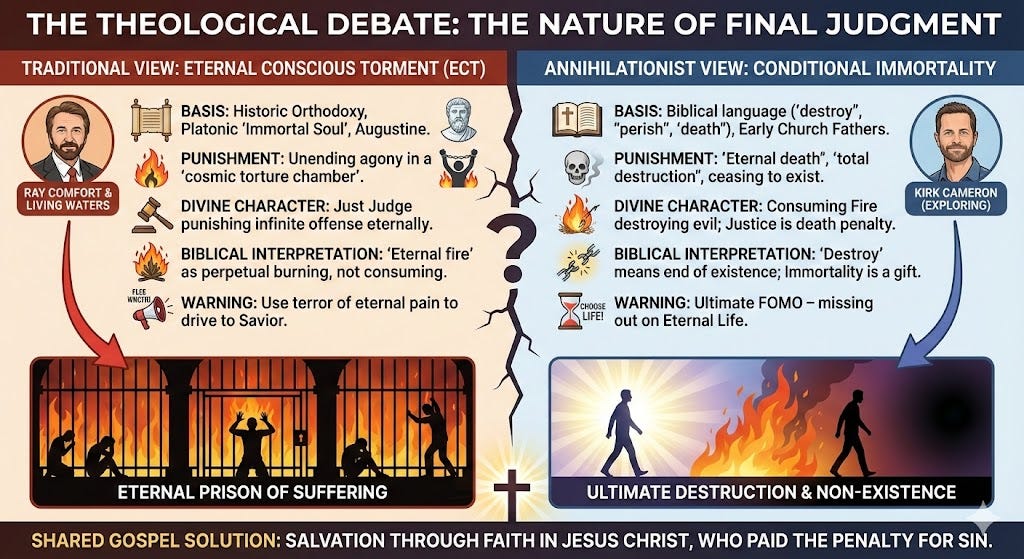
But on the matter of the final prognosis, which is the ultimate fate of the wicked, the duo has diverged. Ray Comfort, a man of unimpeachable zeal, holds fast to the traditional view. He believes that the God of the Universe intends to operate a cosmic torture chamber where billions of human beings are kept artificially alive for the sole purpose of being in agony ad infinitum.
Kirk Cameron, however, has committed the crime of reading the Bible without his Platonic spectacles. He has ventured into the camp of Annihilationism, also known as Conditional Immortality. To put it bluntly, he is right. The doctrine of Eternal Conscious Torment is not only a moral monstrosity, but it is also a theological absurdity that finds its roots not in Jerusalem, but in the philosophical academies of Greece.
The Logic of the Electric Chair
Ray Comfort, in his brilliance, often uses a courtroom analogy. He tells the sinner that they have broken the Law. He explains they are facing the death penalty, and it is as if they are strapped to the electric chair.
Precisely.
If a judge sentences a man to the electric chair, pulls the switch, and the man dies, justice is served. The sentence was death. But if the judge pulls the switch and gives the man a non-lethal shock, keeps him alive, feeds him vitamins to ensure he doesn’t expire, and then shocks him again every hour on the hour for fifty years, that is not a death sentence. That is the behavior of a sociopath.
The Bible is relentlessly clear on this point, yet we have plastered over it with tradition.
-
Romans 6:23: “The wages of sin is death.” It does not say the wages of sin is eternal existing in agony.
-
Matthew 10:28: Jesus, who we are told spoke more of hell than anyone, warns us to fear Him who can “destroy both soul and body in hell.” He does not say preserve both soul and body in torture.
-
John 3:16: The most famous verse in history offers two options. The options are Eternal Life or Perishing.
Kirk Cameron’s shift is simply an acknowledgment that words have meaning. If God says He will “consume” the wicked like chaff, as seen in Matthew 3:12, He means they will be consumed. When fire meets chaff, the chaff does not burn forever. It burns up. It becomes ash. To argue otherwise is to do violence to language itself.
The Atonement: The Math Must Balance
The most damning argument against the traditional view is found at the foot of the Cross. This is the cornerstone of our faith, for Christ took our place. He bore the penalty we deserved.
If the penalty for sin is Eternal Conscious Torment, then for justice to be satisfied, Jesus would have needed to suffer eternal conscious torment. However, we know this is not what happened. Jesus suffered on the cross, died, was buried, and rose on the third day. He did not remain in the grave, nor did He remain in a state of torture for eternity.
When Jesus cried out, “It is finished,” He had fully paid the debt of sin. If the debt was eternal torture, His payment would be incomplete. But if the wages of sin is exactly what Romans 6:23 says it is, which is “death”, then Jesus paid that price perfectly. He experienced the terrifying reality of death and the withdrawal of God’s sustaining life so that we might have life.
If the wages of sin is death, then Jesus paid it in full. But if the wages of sin is eternal torture, then we are still in our sins because Jesus did not suffer for eternity. The traditional view makes a mockery of the Atonement. It suggests that the price Jesus paid, which was death, was different from the price the wicked must pay, which is supposedly eternal torture. Kirk Cameron has spotted this discrepancy, and he is right to call it out.
The “Policy Defense”: A History of Holy Cruelty
We must also possess the intellectual honesty to look at the pedigree of this doctrine. The idea of the “immortal soul,” meaning that humans are inherently indestructible, is pure Platonism. It was imported into the church, and it effectively infected the Hebrew scriptures with Greek philosophy.
Once established, this doctrine of Eternal Torment became a convenient tool for ecclesiastical tyranny. It served as a “policy defense” for the indefensible. During the Medieval ages and the Reformation, when the church burned heretics at the stake, they justified their cruelty with a terrifying logic. They reasoned that if God is going to burn this man for eternity in the basement of the universe, there is no reason to hesitate in burning him for twenty minutes here on earth. They thought that perhaps the victim would convert in the midst of torture and be spared going through it for eternity.
The doctrine of eternal torture provided the moral license for the Inquisition. It painted God as the Ultimate Inquisitor. If we strip away this accretion and return to the biblical view that God is a Consuming Fire who blots out evil rather than preserving it, we find a God of justice. We do not find a God of sadism. We find a God who cleanses His universe rather than one who maintains a dungeon of screaming souls forever.
The Lobotomized Heaven
And what of the saved? The traditional view asks us to believe in a psychological impossibility regarding the joy of the Lord.
We are told in Revelation 21:4 that in the New Heaven, “He will wipe every tear from their eyes. There will be no more death or mourning or crying or pain.” A beautiful promise. But under the traditional view, this promise is a lie.
How can a mother, standing in the glory of the New Jerusalem, possibly know joy if she is aware that her unrepentant son is, at that very moment, writhing in screeching physical agony? And how can she rejoice knowing that he will continue to do so a million years hence? Unless God performs a divine lobotomy on the saved, stripping them of their memory and empathy, Heaven would become a psychological hell.
The Annihilationist view, which is the view that the wicked are “destroyed forever” as stated in Psalm 92:7, resolves this dissonance. The grief of the saved is the grief of a funeral, not the trauma of a torture chamber. We can mourn a death. We can mourn the loss of a life that could have been. But we cannot endure the knowledge of unending, present-tense torture of those we loved.
The Ultimate FOMO
Some, like our dear brother Ray Comfort, worry that without the threat of eternal fire, men will not fear God. They fear we are softening the Gospel.
Nonsense. Is the threat of total, irreversible annihilation not terrifying?
The Gospel that Kirk Cameron is exploring presents the ultimate FOMO, the Fear Of Missing Out on a cosmic scale. The reward of the Gospel is not merely “not being tortured.” The reward is Life. It is to be an heir of the universe. It is to participate in the restoration of all things.
The alternative is to be erased. To be blotted out of the Book of Life. To lose one’s very self. The wicked are not granted the supernatural gift of immortality solely so they can be abused. They are denied the gift of immortality, and thus they perish. They miss the party. They miss the meaning of existence. That is a fate that should make any rational man tremble, without needing to resort to the cartoonish imagery of devils with pitchforks.
Conclusion: A Plea for Consistency
We love Ray Comfort. We love his passion, his fidelity to the Gospel, and his love for the lost. But on this issue, he is defending a fortress that Scripture has long since abandoned.
Kirk Cameron is doing the hard work of a Berean. He is searching the Scriptures to see if these things are so. He has realized that a God who tells us to love our enemies would not then proceed to torture His own enemies for trillions of years.
The view of Annihilationism does not diminish Christ. It magnifies the victory of His resurrection. It paints a picture of a future where God is “all in all” (1 Corinthians 15:28), not “all in most, with a basement full of screaming.” It is time we joined Kirk in having the courage to say that the wages of sin is exactly what God said it was: Death. And the gift of God, and God alone, is eternal life.
The Historical Precedent
It is a common misconception that Annihilationism is a modern invention or a “cultic” deviation. In reality, the view that the soul is not inherently immortal and that the wicked will eventually cease to exist has a rich pedigree going back to the earliest days of the Church, before the heavy influence of Greek philosophy (Platonism) solidified the doctrine of Eternal Conscious Torment (ECT).
1. The Apostolic Fathers (The Earliest Voices)
The earliest Christian writers, who were often disciples of the Apostles themselves, frequently used language that emphasizes destruction and death rather than eternal torment.
-
Ignatius of Antioch (c. 35–107 AD): A disciple of the Apostle John. In his letters, Ignatius contrasts “life” with “death,” not “bliss” with “torture.” He writes that without Christ, we “die” and cease to be. He viewed immortality as a prize to be won, not an inherent property of the human soul.
“For if He were to imitate us according to our deeds, we should cease to be.” — Epistle to the Magnesians
-
Polycarp of Smyrna (c. 69–155 AD): Another disciple of John. While he spoke of “eternal fire,” his focus was often on the resurrection of life versus the resurrection of judgment/death. He prayed at his martyrdom that he might be received in the “resurrection of eternal life,” implying the alternative was a permanent death.
-
The Didache (c. late 1st Century): One of the earliest Christian documents (a manual for church order). It presents the “Two Ways”: The “Way of Life” and the “Way of Death.” It does not present a “Way of Eternal Torture.” It states that the wicked shall “perish.”
2. The Apologists (Defending the Faith)
As the Church began to engage with Greek culture, Apologists explicitly fought against the Greek idea that the soul was naturally immortal. They argued that only God is immortal.
-
Justin Martyr (c. 100–165 AD): One of the most significant early defenders of Christianity. He explicitly rejected the Platonic view that the soul lives forever by its own nature.
“But I do not say, indeed, that all souls die… The souls of the pious remain in a better place, while those of the unjust and wicked are in a worse, waiting for the time of judgment. Thus some which have appeared worthy of God never die; but others are punished so long as God wills them to exist and to be punished.” — Dialogue with Trypho (Note: Justin allows for punishment, but clearly states it lasts only as long as God wills the soul to exist, implying an eventual end/destruction.)
-
Irenaeus of Lyons (c. 130–202 AD): A giant of theology who wrote Against Heresies. He argued that created beings (humans) only exist because God gives them life. If they reject God, they lose that life.
“He who shall preserve the life bestowed upon him, and give thanks to Him who imparted it, shall receive also length of days for ever and ever. But he who shall reject it, and prove himself ungrateful to his Maker… deprives himself of continuance for ever and ever… and shall not receive from him length of days for ever and ever.” — Against Heresies
-
Arnobius of Sicca (c. 303 AD): He wrote vigorously against the pagan idea of the immortal soul, arguing that the soul is “neutral” and can be destroyed. He described the fate of the wicked as being “annihilated” after a period of suffering.
3. The Shift: When Did “Eternal Torment” Take Over?
If the early view was so focused on “Life vs. Death,” how did Eternal Conscious Torment become the majority view?
-
Tertullian (c. 155–220 AD): The “Father of Latin Theology.” He was a lawyer by trade and had a fiery temperament. He is often cited as the first major theologian to explicitly and aggressively defend the idea that the wicked would be tortured forever in a fire that burns but does not consume. He famously (and somewhat gleefully) wrote about watching the wicked burn in the afterlife.
-
Augustine of Hippo (354–430 AD): The most influential theologian of Western Christianity. Augustine cemented the doctrine of ECT. He utilized Greek philosophy (Neo-Platonism) to argue that the soul cannot die, therefore “death” in scripture must mean “eternal misery.” Because of Augustine’s massive influence, this became the standard orthodoxy for over a thousand years.
4. Modern Theological Giants
You are also in good company with more recent evangelical scholars who have questioned tradition:
-
John Stott: The renowned evangelical Anglican leader (author of Basic Christianity). He tentatively embraced Annihilationism, calling it “biblically and morally superior” to the traditional view.
-
F.F. Bruce: One of the 20th century’s most respected biblical scholars. He expressed openness to Conditional Immortality.
-
Edward Fudge: A conservative scholar whose book The Fire That Consumes is considered the definitive modern defense of Annihilationism.
-
Clark Pinnock: An influential evangelical theologian who argued that the traditional view turns God into a torturer.