
A rare “en banc” hearing suggests the court may be preparing to overturn decades of legal precedent regarding religious displays in schools.
TLDR
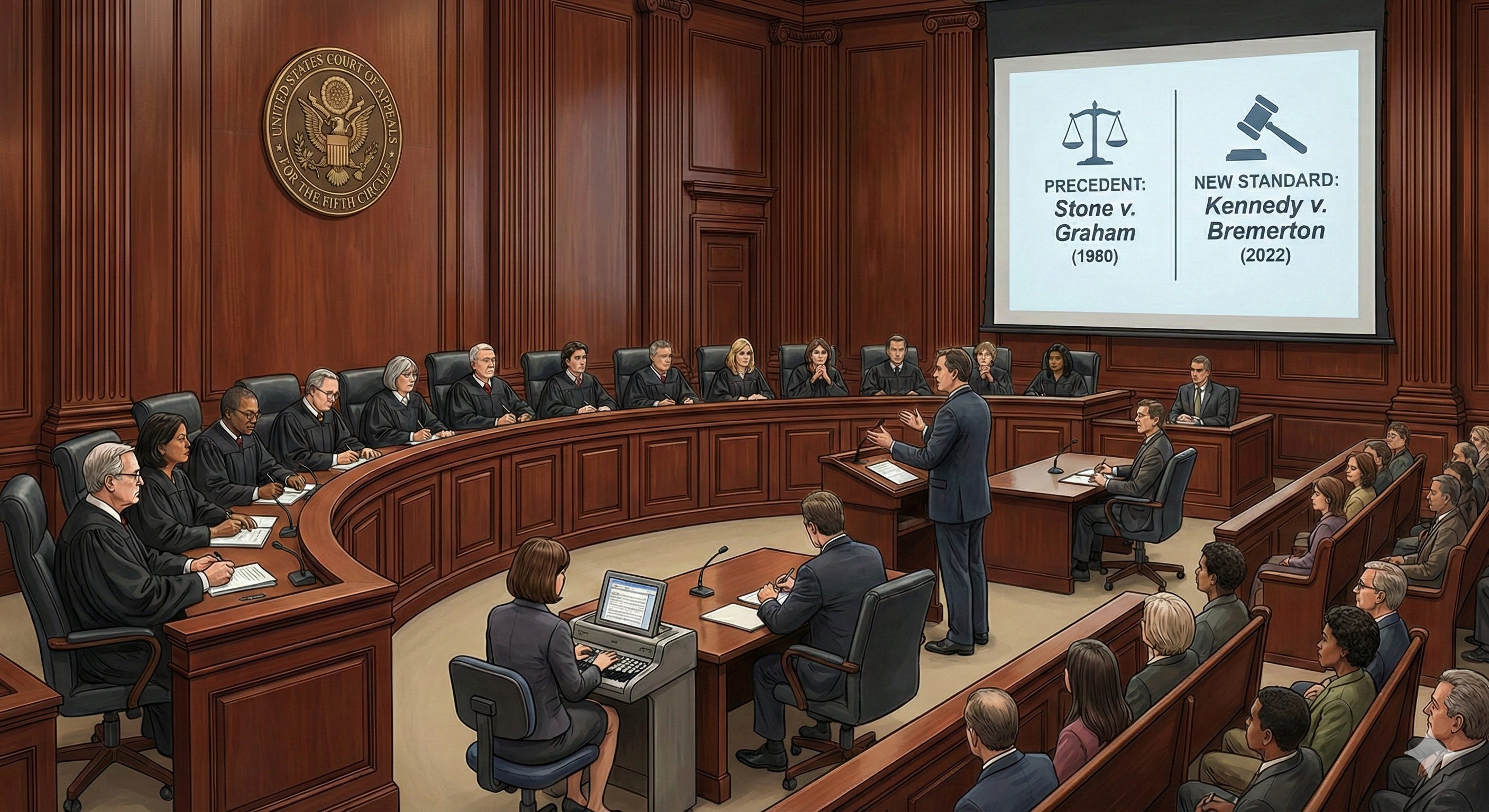
On January 20, 2026, the full 5th U.S. Circuit Court of Appeals heard oral arguments in Roake v. Brumley and Nathan v. Alamo Heights ISD. The 17-judge panel is reconsidering whether Louisiana and Texas can mandate Ten Commandments displays in public classrooms. Lower courts previously blocked these laws based on the 1980 Supreme Court ruling Stone v. Graham. However, the 5th Circuit vacated that decision to rehear the case “en banc.” This procedural move often indicates the court intends to reverse the panel and uphold the laws. Proponents argue the displays are historical, not coercive. Opponents argue they force religion on a captive student audience. A ruling favoring the states would directly challenge Supreme Court precedent and likely force a final showdown at the High Court.
Case Info: Roake v. Brumley (Louisiana) and Nathan v. Alamo Heights Independent School District (Texas) | Link to Oral Arguments
The 5th Circuit May Clear the Way for Religious Displays
Yes, the 5th Circuit Court of Appeals appears poised to reverse lower court rulings and allow Louisiana and Texas to mandate Ten Commandments displays in public schools. The decision to vacate a previous panel ruling and hear the case with all 17 active judges signals a high probability that the court will shift current legal interpretations. If they rule in favor of the states, the decision will set up a direct conflict with the Supreme Court’s 1980 Stone v. Graham precedent.
Why is this hearing happening now?
This hearing represents a critical test of the Supreme Court’s 2022 Kennedy v. Bremerton decision. That ruling abandoned the “Lemon test” (which focused on secular purpose) in favor of a “history and tradition” standard. Louisiana and Texas lawmakers passed these laws specifically to test whether this new standard permits religious displays that were previously banned. The 5th Circuit’s decision will determine if Kennedy effectively overruled Stone or if the ban on classroom religious displays remains in force.
What are the arguments for the state laws?
Attorneys for Louisiana and Texas rely heavily on the argument that the Ten Commandments are a historical foundation of Western law rather than strictly a religious text.
• Historical Foundation: The states contend the Commandments are comparable to the Declaration of Independence or the Magna Carta. They argue that teaching the history of law requires acknowledging this document.
• Passive Speech: The states argue a poster on a wall is “passive.” They distinguish this from a teacher leading a vocal prayer.
• Voluntary Viewing: When judges asked about students who object, Louisiana Attorney General Liz Murrill argued students can simply “not look at them.” The state maintains that mere exposure does not constitute unconstitutional coercion.
Why do opponents claim the laws are unconstitutional?
The ACLU and families opposing the measures argue the laws violate the Establishment Clause by favoring one religion over others in a mandatory setting.
• Captive Audience: Opponents highlight that students are legally required to attend school. They argue this makes the “look away” defense invalid since children cannot leave the room to avoid the religious message.
• Sectarian Bias: The challengers note the statutes require a specific Protestant translation. They argue this excludes Catholic, Jewish, and non-religious students.
• Binding Precedent: They maintain that Stone v. Graham specifically struck down classroom Ten Commandments displays. They argue lower courts must follow Stone until the Supreme Court explicitly overrules it.
How did the judges react during the arguments?
The 17-judge panel appeared sharply divided. The exchanges revealed a court grappling with where to draw the line between history and religion.
• Conservative Skepticism: Some questioned the challengers’ logic. Another asked why the Pledge of Allegiance is constitutional if the Ten Commandments are not. They suggested banning the Commandments might logically lead to banning the Declaration of Independence.
• Liberal Concerns: One pressed the states on the limits of their argument. He asked if the state could mandate other religious texts or read them aloud. He noted the Commandments differ from the Declaration of Independence by issuing explicit religious orders like “Thou shalt not.”
What is the expected outcome?
The court has no deadline to issue a ruling. However, the decision to hear the case en banc suggests a ruling in the next 4-6 months. The conservative majority on the 5th Circuit makes a reversal of the lower court likely. If the 5th Circuit upholds the laws, the challengers will almost certainly appeal to the Supreme Court. This would force the High Court to decide if Stone v. Graham is still good law.
Commentary
The 5th Circuit’s decision to go en banc is a tactical move that could signal that a reversal is coming. Appellate courts rarely vacate panel decisions unless the full court believes the panel got it wrong or the issue is of massive institutional importance. Here, you have both. The conservative majority on this circuit has been aggressive in testing the boundaries of Supreme Court precedents. They know Stone v. Graham stands in the way. By hearing this en banc, they are likely preparing an opinion that argues Kennedy v. Bremerton implicitly overruled Stone, giving the Supreme Court a perfect vehicle to bury the 1980 precedent for good.
The “passive display” argument is the key legal wedge here. For decades, courts viewed classroom displays as inherently coercive because children are impressionable and cannot leave. The states are flipping that logic. They are arguing that if a display doesn’t force a student to do anything—like pray or recite—it isn’t coercion. If the 5th Circuit buys this, it redefines “coercion” to mean only “forced action” rather than “psychological pressure.” That shift would open the door to all manner of religious displays in public buildings, provided they remain silent.
Opponents are right to worry about the specific text requirement. The moment the state picks a translation, it picks a theology. For instance, even within Christianity and Judaism, the King James Version of the Commandments is not the same as the Catholic or Jewish versions. The numbering is different. The wording is different. By mandating one version, the state is not just honoring history; it is engaging in theological editing. The “history and tradition” test from Kennedy is vague enough that the 5th Circuit might wave this away, but it remains a glaring constitutional vulnerability.
This case is not really about Louisiana or Texas schools anymore. It is about the Supreme Court. The 5th Circuit is effectively teeing up a ball for the Justices in Washington. If the 5th Circuit upholds these laws, they force the Supreme Court to either affirm the expansion of religious expression in schools or slap down a lower court for moving too fast. Given the current makeup of the Supreme Court, the 5th Circuit likely bets the Justices are ready to welcome the Ten Commandments back into the classroom.
Citations
• “Fifth Circuit Hears Arguments in Challenges to Ten Commandments Displays in Texas and Louisiana Public School Classrooms.” ACLU Texas, 20 Jan. 2026, https://www.aclutx.org.
• “Roake v. Brumley, No. 24-30706.” Justia Law, 20 Jan. 2026, https://law.justia.com.
• Thomsen, Jacqueline. “Full Fifth Circuit Wary of Ten Commandments Laws’ Challengers.” Bloomberg Law, 20 Jan. 2026, https://news.bloomberglaw.com.
• “Fifth Circuit U.S. Court of Appeals hears arguments over Ten Commandments.” Louisiana Radio Network, 21 Jan. 2026, https://louisianaradionetwork.com.
Support ReligiousLiberty.TV: If you value staying informed on these critical legal battles, please like, share, and subscribe to ReligiousLibertyTV.substack.com. Subscribers get instant access to breaking news and in-depth case information.
Legal Disclaimer: This does not constitute legal advice. Readers are encouraged to talk to licensed attorneys about their particular situations.
Tags: 5th Circuit Court, Ten Commandments, Roake v Brumley, Establishment Clause, Religious Liberty
Holding: The 5th U.S. Circuit Court of Appeals is reconsidering whether Texas can mandate Ten Commandments displays in public classrooms, potentially overturning the 1980 Supreme Court ruling Stone v. Graham.
Holding: A preliminary injunction blocking Louisiana's Ten Commandments display law is vacated because plaintiffs' legal challenge is not yet ripe for judicial review due to school boards' discretion over display nature.
Holding: The Supreme Court abandoned the Lemon test in favor of a history and tradition standard for evaluating religious expression.
Holding: Religious displays, including the Ten Commandments, cannot be mandated in public classrooms.
