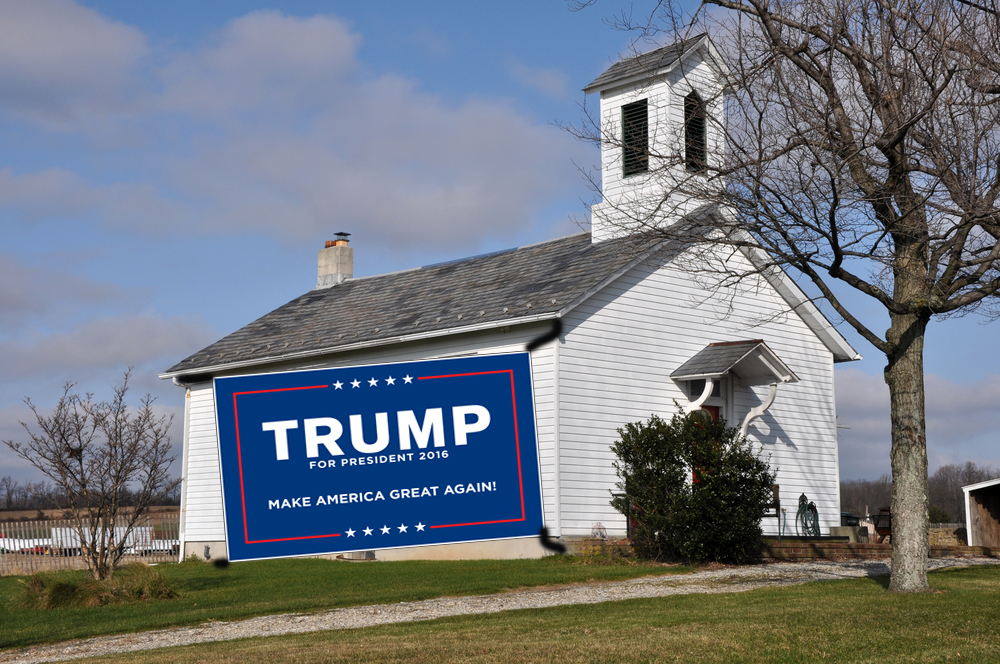
[dc]A[/dc]lthough he has actively courted evangelicals in recent months, Donald Trump took a more distant approach last night as he pivoted toward the center during his acceptance speech at the Republican National Convention. The only time he mentioned his evangelical supporters was to thank them for their support and to call for the repeal of a tax rule, known as the Johnson Amendment, that bars all non-profits, including churches, from campaigning for or against political candidates from the pulpit.
Trump said, “At this moment, I would like to thank the evangelical community who have been so good to me and so supportive. You have so much to contribute to our politics, yet our laws prevent you from speaking your minds from your own pulpits.
“An amendment pushed by Lyndon Johnson, many years ago, threatens religious institutions with a loss of their tax-exempt status if they openly advocate their political views.”
Then, in a departure from the prepared speech, Trump ad-libbed, “Their voice has been taken away.”
Returning to the prepared speech, he said, “I am going to work very hard to repeal that language and to protect free speech for all Americans. “
Although some believe that the electioneering ban has something to do with separation of church and state, it is actually based on an agreement that non-profits of all types make with the IRS. In 1954, Johnson, then a senator from Texas, pushed for the language for political reasons after a nonprofit foundation (incidentally not a religious organization) had supported his opponent and it was passed without much debate.
To obtain 501(c)(3) tax-exempt status, applying organizations must represent that they will not participate in any political campaign on behalf of, or against, any candidate for political office. Failure to abide by the restriction could lead to the revocation of tax-exempt status.
Politicians would love to have churches campaigning for them. Not only would churches be able to claim “moral authority” for promoting “God’s chosen” candidate over another, but they could create an opportunity for campaign donors to deduct their political donations. As it stands, political campaign donations are not tax-deductible, but contributions to 501(c)(3) organizations can be deducted. If the ban were eliminated, a loophole would be created in the code allowing tax-deductible donations to churches to be used to advance political campaigns.
Large churches could bankroll entire political campaigns and, in turn, expect favorable treatment from their preferred candidates. Parishioners could expect to be fed a stream of political positions interspersed with sermons, and the preaching of the gospel could take on a distinctly red or blue flavor, depending on the congregation. Around election time, on any given Saturday or Sunday, church services would become local political conventions, and parishioners would spend the afternoon discussing the merits of their church’s decision to place a Trump banner on the wall just below the steeple.
Contrary to Trump’s representation, the voices of individual church members, or even church employees, have not “been taken away.” Instead, leaders may independently advocate for or against any candidates of their choosing. The only limitation is that they, like any other non-profits, cannot use their organizations as vehicles for doing so. Churches and charities are still welcome to speak truth to power on the larger issues of the day.
Most churches understand the 501(c)(3) limitations, but some churches do promote certain candidates in violation of the rule, sometimes as a form of protest. Enforcement actions are very rare. However, most pastors recognize the potential danger that campaigning could destroy their churches from the inside out, and while they may privately share their political opinions, they actively avoid campaigning on behalf of their churches and avoid the risk of alienating church members who do not share their opinions
Ultimately, the Johnson Amendment protects churches from themselves.
Jesus said, ‘My kingdom is not of this world. John 18:36 9 (NIV)

2 comments
I appreciate the important issue your website focuses on, but there is much misinformation in this article, and in the media on this subject.
First, the following statement from above is not accurate:
>>>”the Johnson Amendment, that bars all non-profits, including churches, from campaigning for or against political candidates”<<<
I refer you to the US Internal Revenue Code, Section 501(c) (I encourage you to read it for yourself and don't take anyone's word for it). Please do a search for the term "non-profit." It occurs 15 times (perhaps surprisingly, not once in Section 501(c)(3).) Only in the case of Section 501(c)(29) (enacted in 2010) does the prohibition on political activity apply to non-profits. None of the other non-profits have the same restriction.
Second, the Johnson Amendment singled out Section 501(c)(3) organizations for this restriction. The aim was to silence right-wing anti-communist educational institutions in their attacks on Senator Johnson. As correctly noted in your article, the amendment was not aimed at religious organizations, but those educational organizations who worried the incumbent senator in his reelection campaign in 1954. (Indeed, it "passed without much debate." There was NO debate on the amendment.) That for the purposes of religious liberty the amendment is being defended today is indeed curious.
Third, for 56 years (until 2010), Section 501(c)(3) organizations were the only tax exempt organizations under an IRS enforced prohibition from participating in the political process. More than 30 other tax exempt organizations (see IRS Publication 557) do not have this prohibition. Unions, chambers of commerce, veterans organizations, and the like may participate to the fullest extent in the political process. No one seriously questions the right or ability of these groups to be politically involved and publicly support candidates that advance their views. What is it about Section 501(c)(3) organizations that makes this so controversial?
Religious liberty is an important issue. I for one support the historical Baptist position that churches should not accept government assistance. I do not think that churches should sully themselves or diminish their credibility by courting politicians. However, I think the idea that churches are singled out to argue for extending the life of this prohibition strikes me as being biased against churches.
The current law puts some religious liberty advocates in the absurd position of mumbling empty platitudes about protecting religious liberty while arguing in favor of extending the IRS oversight of church speech and activities. This does not strike me as advancing religious liberty.
It seems to me that religious liberty would entail more speech on a wider variety of subjects rather than placing some speech and activity off limits, especially when ordinary citizens and even other tax-exempt organizations do not labor under the same restrictions.
Lack of, or selective enforcement of this provision is sometimes glaring. A few elections ago I recall significant threats coming down to be very careful about what gets said in or published by various religious institutions. This chilling effect was clearly meant for conservative churches. While they were scrupulously avoiding even the slightest mention that there was even such a thing as politics, others such as First AME and Brooklyn Tabernacle were not only openly campaining, but hosting election rallies attended by their favored candidates.