
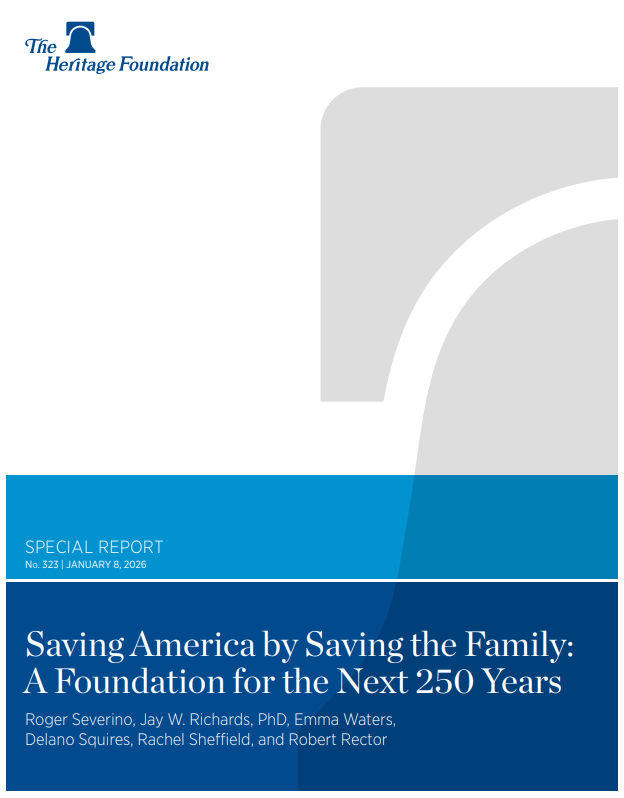
On January 8, 2026, the Heritage Foundation released “Saving America by Saving the Family,” a comprehensive policy agenda authored by Roger Severino, Jay W. Richards, and others. Framed as a “culture-wide Manhattan Project” (Page 6), the report aims to avert a demographic collapse before the nation’s 250th anniversary. Among its most controversial proposals is a call for the restoration of “blue laws” to establish a “uniform day of rest” on Sundays. Relying on the 1961 Supreme Court case McGowan v. Maryland, the authors argue that a synchronized community pause is necessary to combat “spiritual homelessness” (Page 38). This proposal explicitly prioritizes “uniformity” (Page 38) over flexibility, creating a potential legal conflict for Jewish and Seventh-day Adventist communities who observe a Saturday Sabbath.
The following analysis focuses on what is within the text of the original paper itself and does not draw from external information. There will be additional analysis in the near future about the subject, but to be fair to the authors of the paper, this is intended to be reviewed in the context in which the Heritage Foundation issued the proposal.
Here is the link to the document. Pages cited below refer to pages within the document. https://www.heritage.org/sites/default/files/2026-01/SR323.pdf
Does the Document Propose a Return to Blue Laws?
Yes, the Heritage Foundation’s January 2026 report explicitly proposes that states and local communities restore “blue laws” to limit commercial activity on Sundays. The authors argue that a “uniform day of rest” (Page 38) is constitutionally valid and socially necessary to restore family life. While the report praises the family structures of minority faiths like Orthodox Jews, its specific policy recommendation relies on legal precedent that permits the state to designate Sunday as the common day of rest because “the majority of people who take a day of rest for religious reasons do so on Sundays” (Page 38).
Why was this report issued now?
The report is framed as an urgent intervention as the United States approaches its 250th anniversary on July 4, 2026.
-
The Crisis: The authors argue that the “natural family has ceased to be a central organizing reality” (Page 12) and that the nation faces a “population bust” (Page 14).
-
The Goal: The report aims to be “A Foundation for the Next 250 Years” (Title Page), asserting that “when a nation fails to preserve the family, the state soon fails to preserve itself” (Page 1).
-
The Authors: The report was produced by the DeVos Center for Human Flourishing, with lead authors including Roger Severino and Jay W. Richards (Page 1).
What is the specific ‘Uniform Day of Rest’ proposal?
The report explicitly advocates for laws that limit commerce to create a shared community pause.
-
The Justification: The authors argue that “blue laws” provide “temporal boundaries” that allow for “religious observance, family gatherings, outdoor activities, and rest” (Page 38).
-
The Legal Argument: The report cites McGowan v. Maryland (1961), noting that the Supreme Court upheld Sunday closing laws because they serve a secular purpose and “can accommodate the fact that the majority of people who take a day of rest for religious reasons do so on Sundays” (Page 38).
-
Combating Isolation: The authors contend that “restoring a common rhythm of rest and reflection” is necessary to “reverse the trend toward ‘spiritual homelessness’” (Page 38).
Does the plan allow for other days of rest?
It doesn’t mention other days of rest. The text rejects the “on-demand culture” (Page 39) in favor of synchronization.
-
Rejection of Flexibility: The report argues that a “uniform” day is required for communities to “cohere” (Page 38). It does not suggest allowing businesses to choose their own closing day.
-
Legal Reservoir: The authors view the 28 states where some form of blue laws still exist as a “legal reservoir” (Page 38) that should be protected and expanded.
-
Future Communities: The report advises that “Where new, planned communities or transitioning communities form, they should consider adding rest days as part of their master plans” (Page 39).
How does this impact different religious groups?
The proposal creates a distinct advantage for Sunday observers while potentially burdening Saturday observers.
-
Latter-day Saints (Sunday Observers): The report praises “enclaves of Latter-day Saints” for their “cultural norms” that “support families” (Page 27). Since they observe Sunday, a civil closing law would reinforce their existing religious practice without economic penalty.
-
Orthodox Jews & Adventists (Saturday Observers): The report also praises “Orthodox Jews” for maintaining strong family structures (Page 27). (Note: the Sunday law proposal creates a “two-day” conflict. These groups must close Saturday for religious reasons. If forced to close Sunday for civil uniformity reasons, they lose a second day of revenue, putting them at a competitive disadvantage against Sunday-observing businesses that only close once.)
What are the economic and cultural arguments used?
The authors anticipate economic objections and counter them with examples of successful businesses that close on Sundays.
-
Chick-fil-A: The report cites the fast-food chain, noting it “closes its restaurants on Sundays for the benefit of its workers and their families” (Page 39).
-
Existing Closures: It points out that “the U.S. Postal Service does not deliver regular mail on Sundays” and “most banks are closed on Sundays” (Page 39).
-
Online Shopping: The authors argue that “With the advent of on-demand delivery, shopping can be shifted easily and conveniently to other days of the week” (Page 38), reducing the need for physical retail on Sundays.
-
Public Awareness: Beyond laws, the report suggests HHS launch campaigns with messages like “Give her a ring before she gives you a baby” (Page 102).
What’s Next?
The Heritage Foundation describes this effort as a “culture-wide Manhattan Project” (Page 6). Expect this report to serve as the legislative template for the 119th Congress. The “uniform day of rest” proposal is likely to face immediate legal scrutiny, with opponents challenging the “secular” justification used in McGowan given the report’s explicit goal of fostering “religious observance” (Page 38).
Legal & Cultural Analysis
The Heritage Foundation’s reliance on McGowan v. Maryland (Page 38) is a strategic attempt to revive a pre-secular legal standard. In 1961, the Supreme Court permitted Sunday laws by accepting the premise that they were labor regulations, not religious mandates. However, the text of this 2026 report may undermine that defense. By explicitly linking the laws to curing “spiritual homelessness” (Page 38) and encouraging “religious observance” (Page 38), the authors provide evidence that the purpose of the law is indeed religious.
This creates a tension between the report’s stated support for religious freedom and its specific policy prescriptions. While the authors argue that government must “protect and accommodate religious practice” (Page 37), their “uniform” Sunday proposal accommodates the “majority” (Page 38) while potentially burdening the minority. Saturday Sabbatarians (Jews and Adventists) have historically argued that “uniform” Sunday laws act as a tax on their faith. If enacted, this policy would likely force a new Supreme Court test case on whether “majoritarian accommodation” violates the Free Exercise Clause in a pluralistic society.
Sources
-
“Manhattan Project” Quote: Saving America by Saving the Family (Page 6).
-
Uniform Day of Rest / McGowan Citation: Saving America by Saving the Family (Page 38).
-
“Spiritual Homelessness”: Saving America by Saving the Family (Page 38).
-
Chick-fil-A Example: Saving America by Saving the Family (Page 39).
-
LDS/Orthodox Jewish Families: Saving America by Saving the Family (Page 27).
Don’t Miss Out
Subscribe to ReligiousLiberty.TV for breaking analysis on how the “Saving America” report affects your rights. Subscribers get exclusive legal breakdowns of the coming battles over Sunday laws and family tax credits.
AI Disclaimer: This article was assisted by AI. Legal Disclaimer: This does not constitute legal advice. Readers are encouraged to talk to licensed attorneys about their particular situations.
Tags: Blue Laws, Heritage Foundation, McGowan v Maryland, Sunday Closing Laws, Religious Liberty
Holding: The Court upheld blue laws designating Sunday as a day of rest based on secular purposes, which the Heritage Foundation report relies upon to argue for restoration of uniform Sunday rest laws.