On December 16, 2025, the Superior Court of Connecticut dismissed seven out of eight counts in a lawsuit challenging Public Act 21-6, the law repealing religious exemptions for school vaccinations. Judge Rosen ruled that the doctrine of sovereign immunity and the binding precedent of Spillane v. Lamont barred the plaintiffs’ state constitutional claims regarding free exercise, equal protection, and the right to education. However, the court denied the motion to dismiss Count Three. This count relies on General Statutes § 52-571b, a state statute protecting religious freedom. The court found that the legislature implicitly waived sovereign immunity for claims brought under this specific statute. The case will proceed solely on the statutory religious liberty claim against state officials and local boards of education.
Case Information:
-
Case Name: We the Patriots USA, Inc., et al. v. State of Connecticut Department of Education et al.
-
Docket Number: HHD-CV-22-6152413-S
-
Date: December 16, 2025
-
Court: Superior Court, Judicial District of Hartford
The court ruling allows parents to continue their legal challenge against the repeal of the religious vaccine exemption, but only under a specific state statute.
While Judge Rosen dismissed the majority of the plaintiffs’ constitutional arguments due to sovereign immunity, he explicitly allowed the claim based on Connecticut General Statutes § 52-571b to move forward. This statute prohibits the state from burdening a person’s exercise of religion without a compelling reason.
Why this decision matters now
This Memorandum of Decision applies the binding precedent set by the Connecticut Supreme Court in Spillane v. Lamont to the specific claims of We the Patriots USA, Inc. and individual parents. It clarifies the narrow legal path remaining for opponents of Public Act 21-6. The ruling reinforces that while constitutional avenues may be closed by prior high-court rulings, statutory protections enacted by the legislature itself remain a viable mechanism for waiving sovereign immunity and challenging state overreach.
Which claims were dismissed and why?
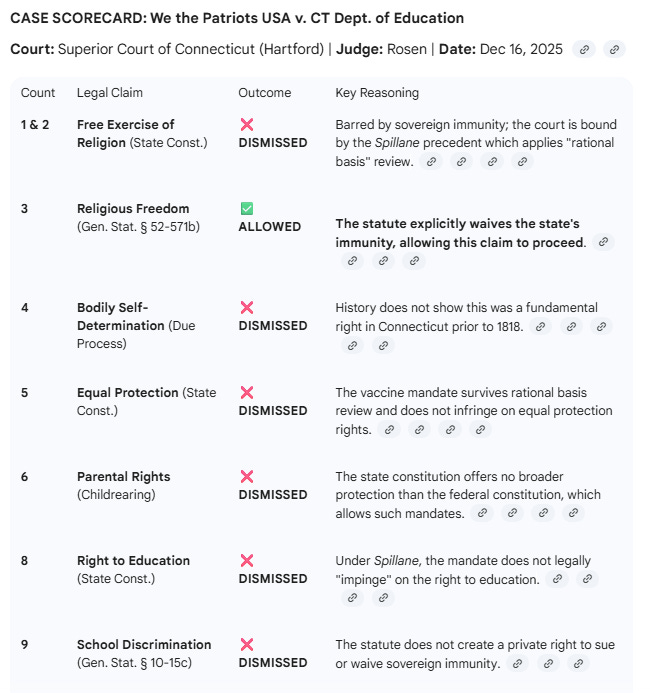
The court granted the defendants’ motions to dismiss counts one, two, four, five, six, eight, and nine. These counts alleged violations of various rights under the Connecticut Constitution, including:
-
Free Exercise of Religion (Counts 1 & 2): The court ruled these claims were barred by sovereign immunity because the plaintiffs could not demonstrate that P.A. 21-6 violated their constitutional rights. The court relied on Spillane, which held that the act is subject to rational basis review and is rationally related to the state’s interest in public health.
-
Equal Protection (Count 5): The court dismissed this claim because the repeal of the exemption survives rational basis review and does not infringe on equal protection rights under the state constitution.
-
Right to Education (Count 8): Relying on Spillane, the court held that P.A. 21-6 does not impinge on the state constitutional right to education.
-
Due Process and Parental Rights (Counts 4 & 6): The court found no historical evidence that the right to bodily self-determination regarding vaccines was a fundamental right at common law prior to 1818. Consequently, the claims failed to overcome sovereign immunity.
-
Statutory Discrimination (Count 9): The plaintiffs alleged a violation of § 10-15c regarding discrimination in public schools. The court dismissed this because the statute does not provide a private cause of action or a waiver of sovereign immunity.
Why did the claim under General Statutes § 52-571b survive?
Count Three alleges that the enforcement of P.A. 21-6 violates General Statutes § 52-571b, which protects religious freedom. The state defendants argued that this claim should be dismissed because the subsequent passage of P.A. 21-6 impliedly repealed § 52-571b or that the claim did not meet exceptions to sovereign immunity.
Judge Rosen rejected these arguments. Citing Spillane, the court noted:
-
Waiver of Immunity: The legislature intended for the waiver of sovereign immunity in § 52-571b to extend to challenges regarding the enforcement of legislation.
-
No Implied Repeal: The text of § 52-571b does not limit the authority of future legislatures, and the passage of the vaccine mandate did not impliedly repeal the religious freedom statute.
-
Conclusion: The claim satisfies the first exception to sovereign immunity because the statute itself waives the state’s immunity.
How does this ruling affect local Boards of Education?
The lawsuit included the Bethel and Glastonbury Boards of Education as defendants. These boards argued that they were acting as agents of the state and were thus entitled to sovereign immunity.
The court agreed with the school boards. Judge Rosen explained that when local boards fulfill statutory duties imposed by the state—such as enforcing vaccination mandates under § 10-204a—they act as agents of the state. Consequently, the sovereign immunity that protects the state defendants also protects the local boards. Therefore, the dismissal of the constitutional counts applies to the school boards, but they remain defendants for the surviving statutory claim in Count Three.
Commentary
The Superior Court’s decision represents a disciplined application of stare decisis while highlighting a critical distinction in American jurisprudence: the difference between constitutional floors and statutory ceilings. The court correctly recognized that it was handcuffed by the Spillane decision regarding constitutional interpretation. When a state Supreme Court declares that a vaccine mandate satisfies rational basis review, a lower court has no maneuvering room to find a constitutional violation that would pierce the shield of sovereign immunity.
However, the survival of the claim under General Statutes § 52-571b is the most vital aspect of this ruling. It demonstrates that a legislature can grant rights that exceed the minimum requirements of the Constitution. Connecticut’s “mini-RFRA” (Religious Freedom Restoration Act) effectively waives the state’s immunity for claims where religious exercise is burdened. This creates a fascinating legal paradox where a law (P.A. 21-6) is constitutionally valid yet potentially statutorily unenforceable if it fails the stricter standards imposed by § 52-571b.
The dismissal of the due process and bodily autonomy claims relies heavily on a historical analysis of common law prior to 1818. The court’s finding that there is no “fundamental right” to refuse vaccination rooted in Connecticut’s history is consistent with the broad police powers recognized in Jacobson v. Massachusetts. Yet, this historical rigidness often fails to account for the modern expansion of the administrative state.
Ultimately, this case now pivots to a pure statutory analysis. The plaintiffs no longer need to prove the Constitution was violated; they must only prove that the state violated its own statute promising religious liberty. This narrows the battlefield but potentially provides firmer ground for the plaintiffs, as the state must now justify its burden on religion under the strict scrutiny standards often embedded in such religious freedom statutes, rather than the deferential rational basis test used for the constitutional claims.
Citations
[1] We the Patriots USA, Inc., et al. v. State of Connecticut Department of Education et al., Docket No. HHD-CV-22-6152413-S, p. 1. [2] Id. at p. 1. [3] Id. at p. 1. [5] Id. at p. 1. [8] Id. at p. 1. [9] Id. at p. 1. [13] Id. at p. 1. [16] Id. at p. 1. [24] Id. at p. 2. [91] Id. at p. 7. [147] Id. at p. 12. [165] Id. at p. 14. [167] Id. at p. 14. [190] Id. at p. 15. [199] Id. at p. 16. [211] Id. at p. 17. [213] Id. at p. 17. [223] Id. at p. 17. [236] Id. at p. 18. [239] Id. at p. 18. [242] Id. at p. 19. [244] Id. at p. 19. [248] Id. at p. 19. [249] Id. at p. 19. [280] Id. at p. 22. [333] Id. at p. 27. [347] Id. at p. 28. [368] Id. at p. 30. [370] Id. at p. 30. [433] Id. at p. 36. [441] Id. at p. 37. [442] Id. at p. 37. [443] Id. at p. 37. [447] Id. at p. 37.
Call to Action For the latest updates on religious liberty cases and breaking legal news, like and share this article. Subscribe to ReligiousLiberty.TV to ensure you receive immediate access to case documents and analysis as they happen.
Disclaimers This article was assisted by AI. This does not constitute legal advice. Readers are encouraged to talk to licensed attorneys about their particular situations.
Tags Connecticut vaccine mandate, religious exemption repeal, We the Patriots USA, General Statutes 52-571b, sovereign immunity legal waiver
Holding: The court dismissed state constitutional claims based on sovereign immunity but allowed a statutory religious liberty claim under Connecticut General Statutes § 52-571b to proceed against vaccine mandate repeal.
Holding: Connecticut Supreme Court precedent establishing sovereign immunity doctrine as binding in religious freedom claims.