
The province introduces sweeping new measures to tighten secularism laws just months before the high court reviews Bill 21.
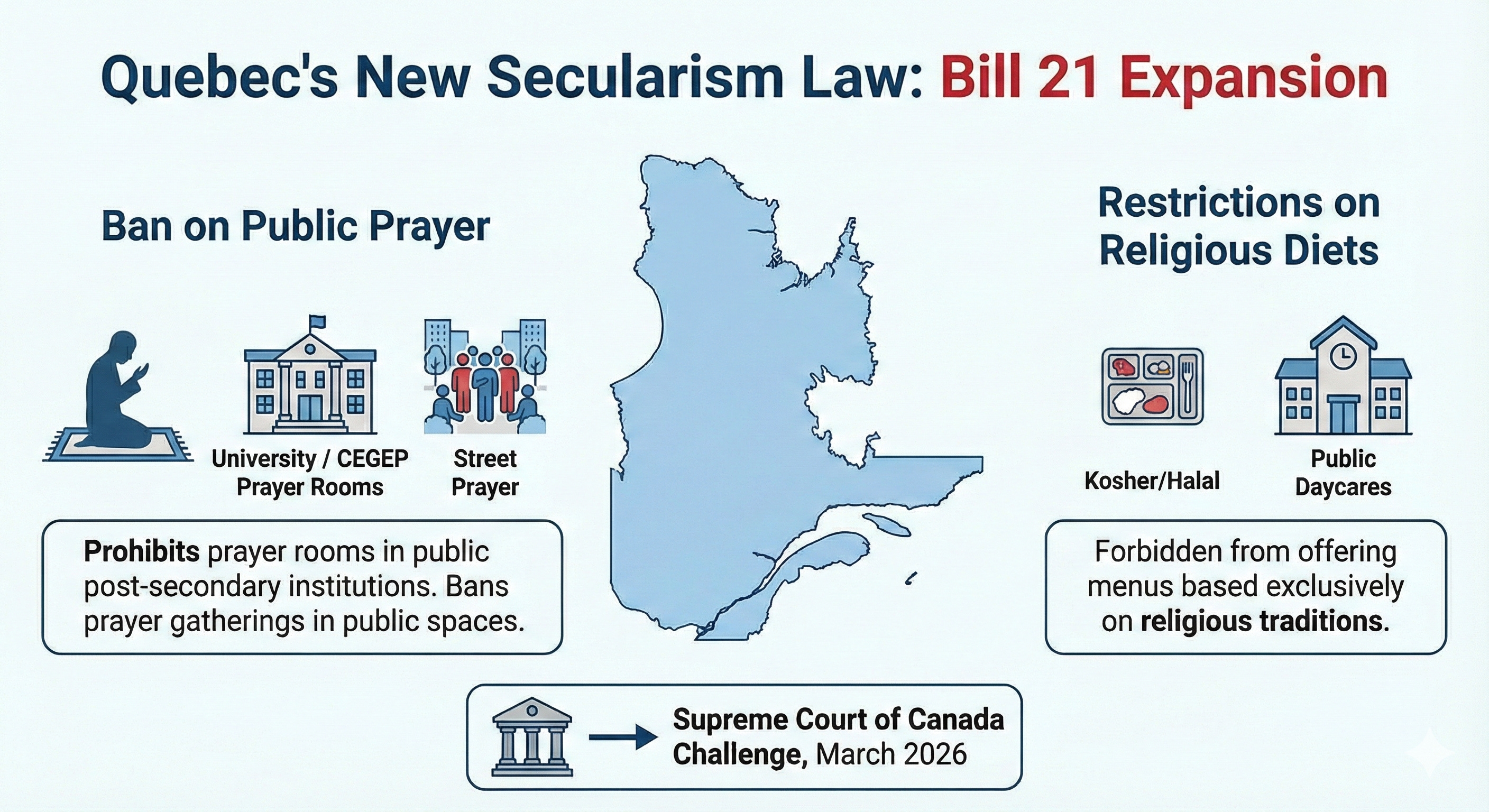
Quebec has introduced new secularism laws that prohibit prayer in public institutions and restrict religious food options. The bill bans prayer rooms at public universities and CEGEPs, outlaws public street prayers, and prevents public daycares from serving exclusively halal or kosher menus. It also gives subsidized private religious schools three years to end religious student selection or risk losing funding. These measures come just ahead of the Supreme Court of Canada’s hearing on Bill 21, which begins March 23, 2026. The provincial government says the laws uphold state neutrality. Civil liberties groups warn they cross into active repression of religious practice. The Court’s ruling is expected later this year.
Case Info: Supreme Court of Canada Appeal (Bill 21) | Hearing Date: March 23, 2026 | Link to SCC Docket
What does Quebec’s new secularism bill include?
The new law introduced in late 2025 widens Quebec’s secularism policy beyond the original Bill 21. It eliminates prayer rooms in public post-secondary institutions, including CEGEPs and universities. It also bans prayer in the streets, particularly when held near religious buildings or public squares. These practices, according to the government, pose a risk of religious pressure or provocation in public settings.
Religious dietary accommodations are now restricted in publicly funded daycares, which may no longer offer menus based solely on religious requirements such as halal or kosher food. The legislation also expands the ban on religious symbols, already in place for many public workers, to include staff at subsidized daycares. Those already employed are allowed to continue under a grandfather clause, but new hires must comply with the ban.
Why is this legislation being introduced now?
The timing of the bill is closely linked to the upcoming Supreme Court of Canada hearing on Bill 21. That hearing begins on March 23, 2026, and will determine whether Quebec’s use of the Canadian Charter’s notwithstanding clause was constitutional. Rather than wait for the Court’s ruling, Quebec’s government has moved forward with new restrictions, suggesting an intent to strengthen and expand its secularism framework regardless of the judicial outcome.
What is the notwithstanding clause, and how is Quebec using it?
The notwithstanding clause, found in Section 33 of the Canadian Charter of Rights and Freedoms, allows governments to temporarily override certain Charter protections, including freedom of religion and freedom of expression. When used, the clause permits a law to remain in force even if it violates constitutional rights. The override lasts five years and must be renewed to remain in effect.
Quebec invoked this clause to protect Bill 21 from legal challenges. The province’s use of this mechanism is central to the upcoming Supreme Court appeal, which will assess whether the clause was applied in accordance with the Constitution and whether it can continue shielding such legislation from judicial scrutiny.
What will the Supreme Court consider in March 2026?
The Court will hear five days of arguments starting March 23, 2026. Justices will evaluate whether Quebec’s use of Section 33 in Bill 21 was appropriate, and whether it permits the province to limit freedom of religion and expression so broadly. They will also review the 2024 ruling by the Quebec Court of Appeal, which upheld most of the law but exempted English-language school boards from its requirements.
Although the new 2025 legislation is not part of the current appeal, the ruling on Bill 21 may influence how similar laws are treated in the future. If the Court limits the scope of the notwithstanding clause, these new measures may face greater legal vulnerability.
How are religious schools affected by the new rules?
Private religious schools that receive public subsidies must stop selecting students or staff based on religion within three years. If they fail to meet this condition, they will lose public funding. The law also requires that religious instruction be optional and scheduled outside of standard classroom hours. Schools may continue offering religious content, but it must not be part of the regular curriculum and may not be tied to admission or employment criteria.
What do supporters and critics of the bill say?
The Coalition Avenir Québec (CAQ) government argues that the legislation is necessary to preserve state neutrality. Jean-François Roberge, the minister responsible for secularism, stated in late 2025 that public institutions must remain free from religious influence and that public prayer or religious meals may create pressure or discomfort for others. These, he said, are inappropriate in state-funded environments (CTV News).
Opponents, including civil liberties organizations, argue that the law moves beyond neutrality and enters the realm of state-imposed secularism. The Canadian Civil Liberties Association said the bill marginalizes religious communities, particularly Muslims and Jews, by making it difficult to observe faith in public life. They contend that removing prayer rooms and religious diets from public institutions creates barriers to access and inclusion (CCLA).
How could the street prayer ban be enforced?
The law prohibits street prayer in areas deemed sensitive or highly visible, such as near houses of worship or civic buildings. The government describes these gatherings as provocative and disruptive, though no evidence has been presented that they have caused disorder. Civil liberties lawyers caution that the measure may violate constitutionally protected freedoms of assembly and religion. Critics say peaceful prayer in public is a form of expression that cannot be banned without clear justification.
What happens next?
The Supreme Court will begin hearing arguments on March 23, 2026, with five days set aside for proceedings. A decision is expected later in the year. While the ruling will directly concern Bill 21, its outcome may shape the legal path forward for the 2025 legislation. If the Court rules that Quebec’s use of Section 33 was too broad or improperly applied, future laws based on the same legal strategy may be subject to greater judicial review.
Case Info:
Supreme Court of Canada Appeal (Bill 21)
Hearing Date: March 23, 2026
Commentary
The 2025 bill marks a shift in Quebec’s approach from separating religion and state to excluding religion from public space. While secularism aims to protect individual freedom of conscience, this legislation imposes uniformity under the label of neutrality. Prayer rooms and religious meals do not represent state religion. They are private accommodations within public institutions. Prohibiting them converts neutrality into suppression.
The introduction of these new restrictions before the Supreme Court hearing appears strategic. If the Court weakens the notwithstanding clause, the legal basis for both Bill 21 and the 2025 bill may fall apart. If the Court affirms Quebec’s broad use of the clause, it could allow future legislation that further restricts public religious expression. In either case, the new law raises the stakes of the Court’s ruling.
The provisions affecting religious schools show the province is not just regulating public space but also shaping private institutions that receive state funds. By attaching conditions that undermine the schools’ faith-based mission, Quebec pressures them to secularize. This is not a neutral policy but a form of ideological enforcement through funding rules.
The street prayer ban also raises serious concerns. Public religious expression, including prayer, is a protected form of assembly and speech. Framing it as provocation risks creating a legal category where any unpopular or visible belief can be restricted. If prayer can be banned in a park, protests can be banned on the same grounds. The long-term consequences of that logic will not be limited to religion.
Subscribe to ReligiousLiberty.TV
Follow every update in this unfolding legal battle. By subscribing, you’ll receive real-time alerts on court developments, case filings, and legal commentary about religious freedom. Visit religiouslibertytv.substack.com to stay informed.
Legal Disclaimer: This article does not constitute legal advice. Consult a licensed attorney for legal questions.
Tags: Quebec Bill 21, Supreme Court of Canada, Religious Liberty, Canadian Charter of Rights, Secularism Law