The Locked Gate: Why Collectivist States Cannot Afford to Let People Leave
TL;DR
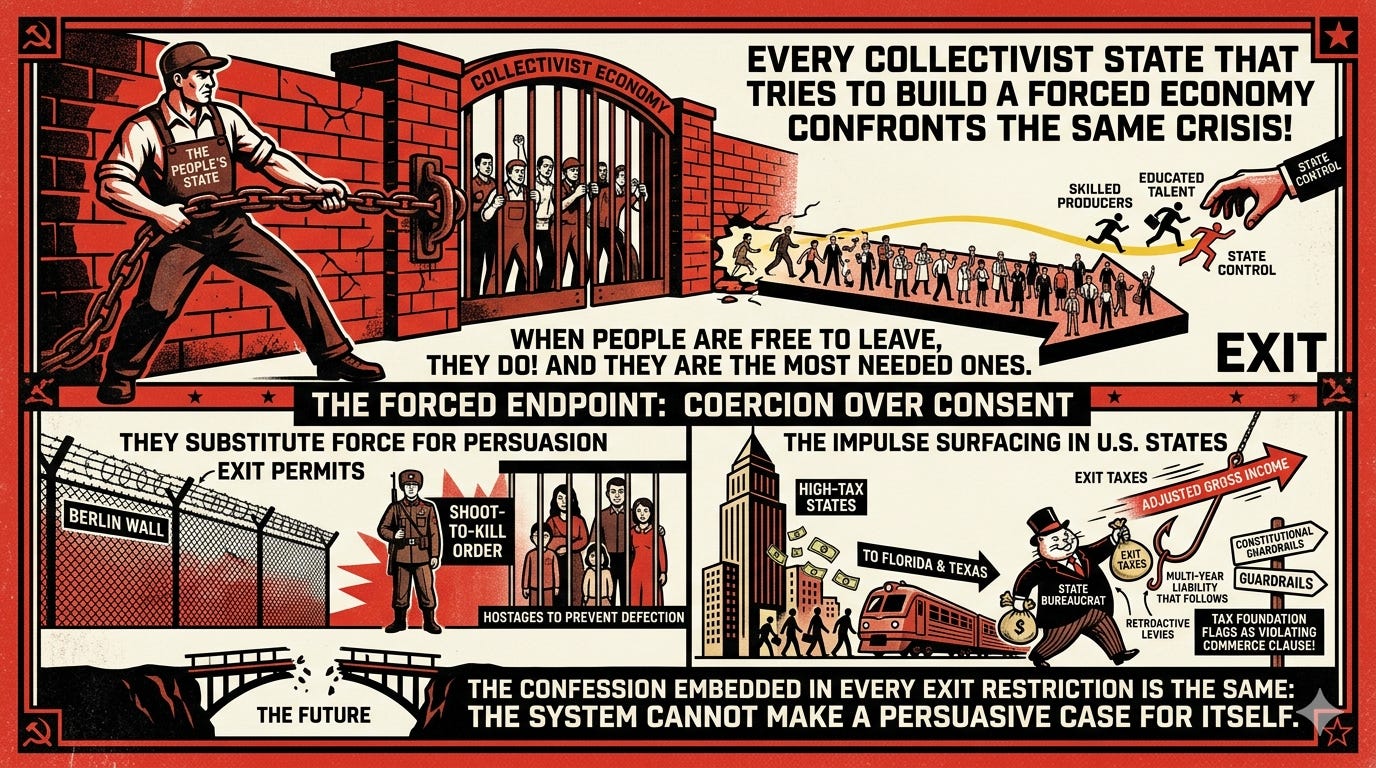
Every communist state that has tried to build a collectivist economy has eventually confronted the same crisis: when people are free to leave, they do, and the ones who leave first are precisely the skilled, educated producers the system needs most. The Soviet propiska system, the Berlin Wall, Cuba’s exit permits, and North Korea’s shoot-to-kill border orders are not historical accidents or expressions of individual cruelty. They are the logical endpoint of any political economy that depends on capturing human capital rather than attracting it. East Germany lost nearly three million people before it built the Wall. North Korea holds family members hostage to keep diplomats from defecting. The confession embedded in every exit restriction is the same: the system cannot make a persuasive case for itself, so it substitutes coercion for consent.
The United States has constitutional guardrails that prevent anything so brutal, but the underlying impulse is surfacing in high-tax states hemorrhaging residents and revenue. California, New York, Illinois, and their counterparts are watching billions of dollars in adjusted gross income walk out the door to Florida and Texas every year, and their legislative response has been to propose exit taxes, retroactive wealth levies timed to prevent departure, and multi-year tax liability that follows former residents across state lines. The Tax Foundation and constitutional attorneys have flagged these proposals as almost certainly violating the Commerce Clause and the right to travel. The political logic driving them, however, is older than the Commerce Clause and far more revealing: a government that must penalize leaving has already lost the argument about why anyone should stay.
Every state that has organized itself around the collective ownership of property, the subordination of individual interest to state planning, and the redistribution of wealth by government command has eventually confronted the same problem. The people it governs, when given the option, vote with their feet. And when the exodus becomes large enough to threaten the system, the system builds walls, issues edicts, and ultimately points guns at anyone who tries to walk away.
This is not a peripheral feature of communism. It is the defining confession of its failure.
The Soviet Blueprint
The architecture of population control in communist states begins with the Soviet Union, where it was developed with bureaucratic precision over several decades. The migration policies of the USSR included a virtual abolition of emigration and immigration, an effective ban on private travel abroad, and pervasive bureaucratic controls on internal migration. 
Internal control came first. The propiska system not only identified individuals but tied them to a specific place of residence, effectively restricting movement within the country.  Under the Soviet system, internal passports were issued at age 16, with a propiska stamped inside. No change of residence could be made without official permission, and failure to register was subject to fines or imprisonment. A valid propiska was required to work, get married, or gain access to education or social services. 
The system trapped people not through brute force alone but through bureaucratic dependency. A Soviet citizen without the correct stamp could not take a job, enroll a child in school, or receive medical care. The state did not merely restrict travel; it made the individual’s entire existence contingent on remaining where the state had placed him.
Foreign travel was considered a privilege rather than a right. Permission to leave the country was granted only to a select few, such as government officials, diplomats, athletes, scientists, and artists representing the state, and even then, their movements were closely monitored. 
The logic behind this arrangement was stated plainly enough, if cynically, by Mikhail Gorbachev himself. When CBS anchor Tom Brokaw pressed him on Soviet emigration restrictions in a televised interview, the Soviet leader self-righteously replied that Western emigration efforts amounted to a “brain drain” and that the Soviet Union was “protecting” itself.  The admission was more revealing than Gorbachev intended. The USSR was not protecting its people. It was protecting itself from its people.
East Germany: Three Million Votes Against Socialism
No episode in the history of communist emigration policy is more instructive, or more damning, than the story of East Germany. The German Democratic Republic was, by the standards of the Eastern Bloc, a relatively prosperous socialist state. It had an educated population, a significant industrial base, and a government genuinely committed to delivering on its Marxist promises. And its people fled in numbers that threatened to hollow the country out entirely.
When the Berlin Wall was built on August 13, 1961, the East German state had already lost nearly three million of its people to West Germany.  The pace of departure in the final months before the Wall’s construction was staggering. In June 1961, some 19,000 people left the GDR through Berlin. The following month, 30,000 fled. In the first eleven days of August, 16,000 East Germans crossed the border into West Berlin, and on August 12, some 2,400 followed, the largest number of defectors ever to leave East Germany in a single day. 
The East German government’s response was not to examine what was driving its citizens away. The Communist government began to build a barbed wire and concrete barrier officially called the “Antifascist Protection Rampart,” though it primarily served the objective of stemming mass defections from East to West.  The Orwellian rebranding barely concealed what the Wall actually was: a government admitting, in concrete and razor wire, that its own citizens regarded their country as a prison.
The loss of East German citizens to the West became too much for both the Germans and the Soviets, especially since those who left were often among the most highly trained and skilled.  Doctors, engineers, professors, and scientists were the ones most determined to leave, because they were the ones most capable of evaluating the comparative merits of the two systems. The Wall was built, in the final analysis, to stop the educated class from making an informed choice.
At least 171 people were killed trying to get over, under, or around the Berlin Wall.  Every one of them represents the terminal cost of a political system that can only sustain itself by imprisoning the people it claims to serve.
Cuba: The Managed Escape Valve
The Castro government developed a variation on the same theme, using emigration not just as a problem to be suppressed but occasionally as a tool to be weaponized. After communist leader Fidel Castro rose to political power in Cuba in 1959, he periodically closed the island’s borders and prevented Cuban citizens from leaving. 
When the pressure became unsustainable in 1980, following an economic collapse and a dramatic incident in which thousands of Cubans rushed the Peruvian embassy seeking asylum, Castro reversed course. The Mariel Boatlift of 1980 was a mass emigration of Cubans to the United States. The exodus was driven by a stagnant economy that had weakened under the grip of a U.S. trade embargo and by Cuban President Fidel Castro’s exasperation with dissent. “Those who have no revolutionary genes, those who have no revolutionary blood… we do not want them, we do not need them,” Castro declared in a May 1, 1980 speech. 
Castro then announced that Cuban exiles could come by small boat to Mariel, a port on the north coast of Cuba, and pick up their relatives. The prosperous Cuban community in Florida launched every boat they owned or could charter and headed to Mariel. More than 125,000 Cubans fled their country over six months. 
Castro’s maneuver was cunning: he turned a mass escape into an opportunity to export criminals and mental patients alongside ordinary refugees, embarrassing the United States while relieving domestic pressure. But the episode confirmed a deeper truth. The Cuban government had always possessed the power to lock the border, and it exercised that power routinely, opening it only when continuing to do so served the regime’s interests. Emigration was not a right. It was a concession Castro made to himself.
North Korea: The Pure Form
If the USSR represented communist exit policy in its bureaucratic form, and East Germany in its desperate form, North Korea represents the ideology in its most naked expression. Emigration is prohibited. Refugees who have escaped to China have frequently been forcibly returned to North Korea, where they are imprisoned, subjected to torture and other ill-treatment, and sometimes executed. The government operates a network of forced labor camps for an estimated 120,000 political prisoners. 
Border troops are under orders to shoot to kill if anyone gets too close to the border. The North Korean side of the border area is covered with land mines and other military devices to kill would-be escapees. 
One escapee who previously worked at a DPRK embassy described how, with few exceptions, the government ensured that at least one immediate relative of overseas personnel remained in the DPRK as a hostage to discourage defections.  The regime takes the deterrence of departure seriously enough to hold families hostage. The children of a diplomat who might consider defecting become leverage. The system does not merely lock the door; it holds your family behind it.
While persons convicted of ordinary crimes serve fixed sentences, those convicted of political crimes are confined indefinitely. Punishment is extended to three generations: the offender’s parents, siblings, and children are also incarcerated, as a way to pressure North Koreans to conform. 
This is collectivism stripped of any pretense. The individual’s desire to leave is treated as an offense against the collective. The family becomes a unit of control. The three-generation punishment is, in effect, a policy acknowledgment that if you let one person choose freely, the idea of freedom spreads.
Why They Can’t Let People Leave
The pattern across every communist state is not coincidental. It is structurally inevitable, and understanding why requires confronting an uncomfortable truth about collectivist economic organization.
Central planning requires a captive workforce. When the state allocates housing, education, and employment, the mobility of labor becomes a threat to the plan. A worker who can relocate freely disrupts production quotas, depopulates designated industrial zones, and drains state investments in training and infrastructure. The propiska system was not merely paranoid; it was a rational response to the logic of central planning.
Beyond economics, there is the problem of political legitimacy. Every person who leaves a collectivist state is a living repudiation of its claims. When a government insists that it has constructed the superior form of social organization, a mass departure does not merely represent an economic loss. It represents a verdict. The 1950s practice of West Germany receiving East German refugees strengthened the view that the people leaving the GDR were “voting with their feet” for a free democratic republic and against the ruling party. The SED countered this with its own interpretation: that Western organizations were systematically “luring” GDR citizens away. 
The regime cannot concede that its citizens are making a rational choice. So the citizens become victims of foreign manipulation, economic migrants deceived by capitalist propaganda, or antisocial elements better purged than retained. In Granma, the Cuban Revolution’s official newspaper, dissidents were deemed “criminals, lumpenproletariats, antisocialists, bums and parasites.”  The man who wants to leave is not exercising judgment. He is exhibiting a defect.
This rhetorical move is essential to every collectivist project. The system cannot be wrong. The person leaving must be.
The American Echo
The United States is not a communist country. Its constitutional structure, property rights tradition, and federalist design stand in fundamental opposition to the command economies described above. But democratic federalism creates its own version of the same tension: states compete for residents, and states with high-tax, high-regulation economies are losing that competition badly.
The response of several of those states to that competitive failure has begun to take on a character that deserves careful scrutiny.
IRS data shows that California had the largest negative net migration, losing 355,809 individuals, followed by New York with 267,156, then Illinois.  According to recent IRS data from 2022-2023, due to migration from blue to red states, California lost just under $12 billion and New York $9.9 billion in adjusted gross income, while Florida gained $20.5 billion and Texas $5.5 billion. 
California loses another taxpayer on net every 1 minute and 44 seconds, followed by New York every 2 minutes and 23 seconds. 
These are not the numbers of a policy debate. They are the numbers of a verdict.
The states losing people at this rate have responded not by examining the cost and regulatory burdens that are driving residents away, but by reaching for a tool with a very specific historical pedigree. In a coordinated effort, lawmakers in seven states, which collectively house about 60 percent of the nation’s wealth, including California, Connecticut, Hawaii, Illinois, Maryland, New York, and Washington, introduced wealth tax legislation. California’s response to the prospect of continued departures: an exit tax, and wealth taxes owed for years after leaving the state. 
The Tax Foundation notes this almost certainly runs afoul of the Commerce Clause of the U.S. Constitution and interferes with the constitutionally protected right of travel. 
California’s proposed wealth tax carries an additional feature that tax attorneys have found remarkable for its audacity. The Billionaire Tax Act would impose a one-time tax of 5 percent on the total wealth of California tax residents whose net worth is $1 billion or more. The proposed tax would apply to those who are California residents as of January 1, 2026. The retroactive date left little time for California’s estimated 200 to 250 billionaires to change their tax residency after they first learned of the potential tax in December. 
Because establishing a change of residency takes time, typically months, attorneys say successfully escaping the proposed California wealth tax would be almost impossible. 
Retroactive effective dates, years-long tax liability after departure, and constitutionally dubious claims of jurisdiction over former residents: these are not the mechanics of ordinary tax policy. They are the mechanics of a state that has concluded it cannot afford to let its most productive citizens exercise their right to leave.
Even if this ballot measure does not pass, wealthy individuals may well decide that they no longer want to live in a state where legislators and activists argue over the best ways to seize their wealth to fuel chronic overspending. Migration trends, already ominous for states like California and New York, are likely only to accelerate. 
The parallel is imperfect, and it matters to say so clearly. California is not building a wall. No one in Sacramento is proposing to shoot tax attorneys who advise clients to establish Florida domicile. The scale of coercion between a democratic state’s exit tax and the Berlin Wall’s death strip is not a subtle difference. It is categorical.
But the impulse is the same, and it comes from the same place. A political economy organized around redistribution and collective provision faces a structural vulnerability that no amount of rhetorical commitment to the common good can resolve. When the producers of wealth can leave, some of them will. And when enough of them leave, the math that sustains the system collapses. The East German Politburo understood this in 1961. Sacramento’s progressive caucus understands it today.
The difference is that in the United States, the courts still function, the Constitution still constrains legislative overreach, and the political opposition still exists to call the question. Attorneys say that the retroactive provision makes California’s proposal a certain target for lawsuits. Taxpayers who left before November could claim the retroactive date violates due process. 
That a proposal this aggressive could advance as far as a California ballot measure represents a meaningful deterioration in the political consensus around the right of mobility. Article 13 of the 1948 Universal Declaration of Human Rights is unambiguous: everyone has the right to leave any country, including his own. The framers of that document had seen what happened to populations that could not.
The Honest Admission at the Center of It All
Every exit restriction, in every country that has imposed one, contains a confession that its architects will never make aloud. A government that must build walls, confiscate passports, shoot defectors, or levy punishing taxes on departing residents is a government that has failed to make a compelling case for itself. It cannot persuade its citizens to stay. So it reaches for the only remaining option.
The Berlin Wall was not, as the East German government claimed, an antifascist bulwark. It was the world’s most expensive proof that East Germans, given the choice, preferred not to live under socialism. The North Korean border apparatus, with its land mines and shoot-to-kill orders, says the same thing in a different dialect. The Cuban exit permit, periodically opened and closed according to the regime’s domestic pressures, says it again.
And when California’s legislature writes a wealth tax with a retroactive effective date designed to prevent wealthy residents from changing their domicile before the tax takes effect, it says it too, in the muted, lawyerly language of a constitutional democracy that has not yet crossed every line but is clearly tempted by them.
Free people, when given the genuine choice, do not generally choose to remain in systems that take more than they give. This is not a political argument. It is a historical observation, written in the population statistics of failed states and the IRS migration data of American ones.
The wall always comes later. The impulse comes first.