
A plaque placed near a holiday display in the Minnesota State Capitol Rotunda reads:
“The Democrat Coalition of Satan Worshippers thanks Gov. Tim Walz for not standing in the way of spreading Satanism in the state Capitol building. Satan has a special place for you.”
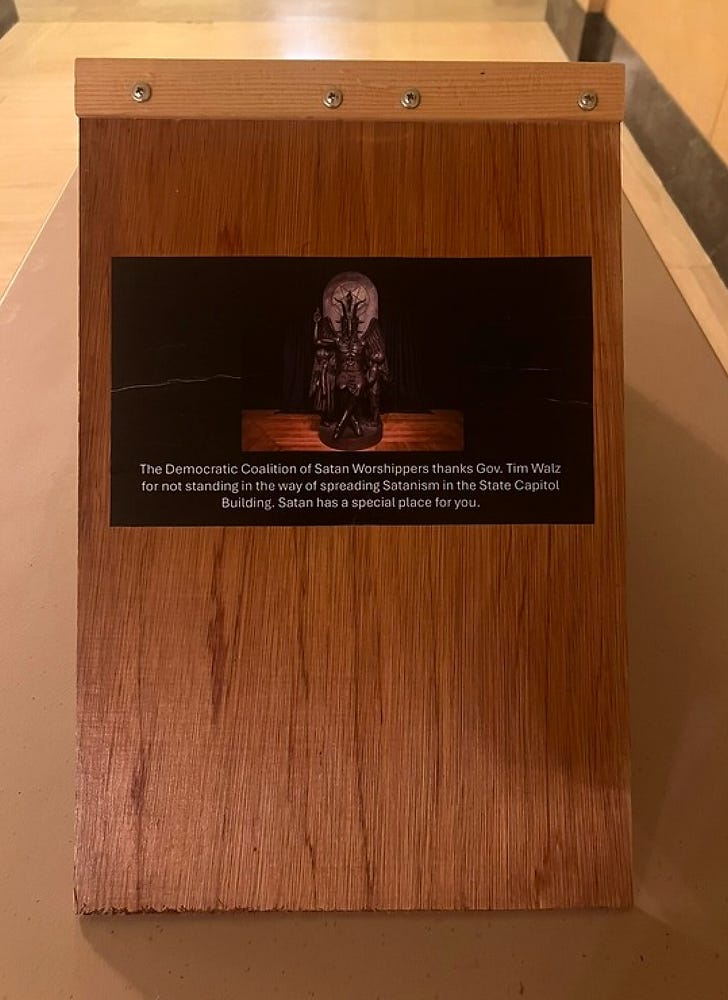
The statement, short and confrontational, set off a wave of criticism after photos of it circulated online. But the legal system surrounding religious expression in public spaces is not based on public reaction. It is grounded in the First Amendment’s guarantees of religious freedom and government neutrality.
The plaque accompanied a holiday installation by the Minnesota chapter of The Satanic Temple, which included a black mirrored cube, paper cranes, lighting, and a pentagram suspended above the structure. The group secured a permit from the Minnesota Department of Administration to place the display in the Capitol Rotunda from December 13 to December 27, 2023. The department stated that issuing a permit to a private group “does not imply endorsement by the State of Minnesota.” (FOX 9)
The Capitol operates under a neutral public access policy. Individuals and groups may reserve space through an application process as long as they meet safety and time limitations. These rules prohibit obstruction of hallways and unsafe materials but do not evaluate the content of speech or displays. The governor does not oversee or approve these permits. A spokesperson confirmed, “The Capitol is a public building… the governor does not have jurisdiction over the permits.” (CBS News Minnesota)
The constitutional issue here is not whether the message is offensive. It is whether the government has treated all groups equally. The First Amendment prohibits government from establishing religion and protects religious expression. Courts have consistently held that if a government opens a space for religious or ideological speech, it must allow all viewpoints to participate under the same rules.
In Capitol Square Review & Advisory Board v. Pinette, 515 U.S. 753 (1995), the U.S. Supreme Court ruled that the Ku Klux Klan had a right to place a cross near the Ohio Statehouse because the plaza had been designated a public forum. The Court held that religious messages delivered by private citizens in an open public space are protected speech, and the government may not exclude them based on content or viewpoint.
This principle applies regardless of whether the message is from a majority faith or a minority belief system. If a nativity scene or menorah is permitted in a state capitol, then other religious groups must also be granted access, including those whose views many may reject. The Court has stated that government neutrality is not favoritism. It is the refusal to take sides.
The plaque in question appears to have been a private addition, placed near the Satanic Temple’s holiday display. There is no evidence that it was created or endorsed by any official government entity. Although the language was viewed as inflammatory by many, the legal standard is not whether a statement is provocative. The question is whether the government is applying access rules in a neutral way.
Lawmakers have since raised concerns and called for changes in how religious displays are handled. But under the Constitution, the only way for the state to limit future messages of this type would be to shut down the forum to all religious and ideological displays. Courts have repeatedly ruled that selective exclusion is not an option under the First Amendment.
As of now, Minnesota has made no changes to its policies. The Capitol Area Architectural and Planning Board has not released a public statement. No lawsuits have been filed in response to the plaque or display.
TLDR (Too Long / Didn’t Read Summary)
A plaque reading “The Democrat Coalition of Satan Worshippers thanks Gov. Tim Walz… Satan has a special place for you” appeared near a holiday display by The Satanic Temple in the Minnesota State Capitol. The group received a state permit for the installation under rules that treat religious displays equally. Constitutional law requires that public spaces opened to religious expression remain open to all groups, including controversial or minority beliefs. The state did not sponsor or approve the message, and no legal action has followed.
Legal Commentary
Under First Amendment law, the government must remain neutral when it allows private religious speech in public spaces. This principle was affirmed in Capitol Square Review Board v. Pinette, where the Court ruled that religious symbols placed by private individuals in an open forum cannot be excluded based on viewpoint.
In Minnesota, the Capitol Rotunda functions as a designated public forum. The state may impose time, place, and safety restrictions, but it cannot block access based on the content of a display. This applies even when the speech is controversial or unwelcome.
The Satanic Temple followed the rules, submitted a permit, and set up its display within the approved timeframe. The plaque’s language may have been provocative, but the First Amendment protects offensive speech as much as popular speech. The state’s role is not to judge intent or theology. It is to apply rules fairly to everyone.
Unless Minnesota closes the forum entirely to all private displays, it cannot ban one group while allowing others. Doing so would almost certainly result in a successful constitutional challenge.
Case Citation
Capitol Square Review and Advisory Board v. Pinette, 515 U.S. 753 (1995)
Full text: https://supreme.justia.com/cases/federal/us/515/753/
Like what you’re reading?
Subscribe to ReligiousLiberty.TV for early access to legal reporting, First Amendment analysis, and updates on religious freedom litigation. Subscribers receive case alerts, commentary, and breaking news directly in their inbox.

Legal Disclaimer:
This article is for informational purposes only and does not constitute legal advice. Consult a licensed attorney for legal guidance related to your situation.
SEO Tags:
Minnesota Satanic Temple display, First Amendment public forum, religious speech government property, church and state separation, Capitol Square v. Pinette
